
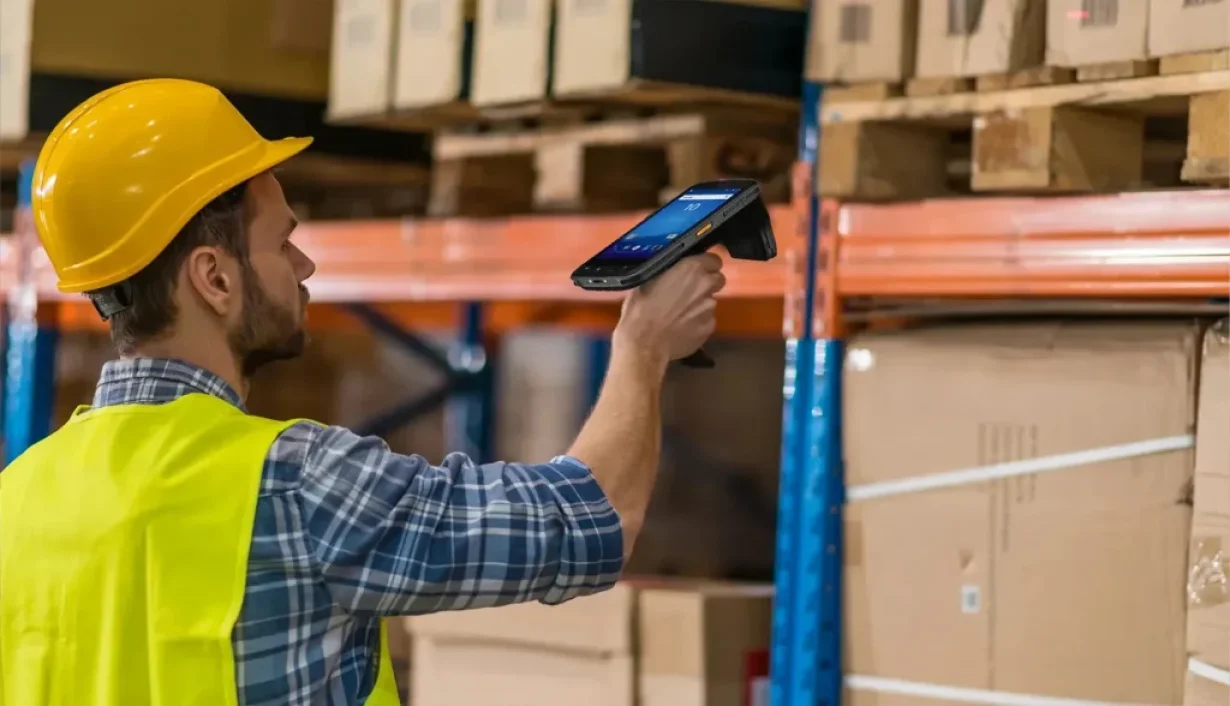

When people search for RFID tracking distance, they are rarely looking for theory. They want a practical answer to a design question: How far away can my system reliably read tags in my real environment? The honest answer is that RFID tracking distance is not a single number printed on a chip datasheet. It is the result of a system made up of frequency, reader power, antenna design, tag construction, orientation, and environmental conditions such as metal and liquid interference. This guide breaks down what truly determines read range, why lab results often differ from on-site performance, and how to design for the distance your application actually needs.
1. What Is RFID Tracking Distance?

In practice, tracking distance is the maximum reliable read range at which a reader can power a tag (for passive systems), receive its response, and decode it accurately under real operating conditions. It differs from:
- Theoretical range measured in controlled lab environments
- Peak range achieved with ideal tag orientation and no interference
- Marketing range sometimes quoted without environmental context
Three common scenarios produce very different outcomes:
- Line-of-sight bench test (best case)
- Portal/doorway read with moving items
- Handheld scanning in dense shelves, metal racks, or near liquids
A system that reads 12 meters on a test bench may only achieve 4–6 meters in a warehouse aisle. That gap is where most RFID projects struggle.
2. RFID Tracking Distance by Frequency
The following table summarizes the typical tracking distances and common uses for different RFID types:
| RFIDタイプ | 頻度 | Typical Tracking Distance | 一般的な用途 |
| 低周波(LF)RFID | 125-134 kHz | 2–10 cm | Animal ID, access control |
| 高周波(HF)RFID | 13.56 MHz | 2–10 cm | NFC cards, payments, ticketing |
| 超高周波(UHF)RFID | 860-960 MHz | 3–15 meters | Warehouse, logistics, retail |
| アクティブRFID | 433 MHz / 2.4 GHz | 30~100メートル以上 | RTLS, vehicle tracking |
3. Why UHF RFID Can Read Meters Away but HF/NFC Cannot

HF (13.56 MHz) systems rely on magnetic (inductive) coupling. The reader creates a magnetic field, and the tag must be inside that field to harvest power. Magnetic fields decay very quickly with distance, which is why HF cards are intentionally short range. This is ideal for secure taps and controlled reads.
UHF (860-960 MHz) uses electromagnetic backscatter. The reader emits radio waves that travel much farther. The tag reflects a modulated signal back to the reader. Because this is a propagating wave rather than a near-field magnetic bubble, the potential RFID tracking distance increases from centimeters to meters.
This is also why:
- Access control prefers HF (precision, anti-collision at close range)
- Warehouses prefer UHF (coverage, speed, bulk reading)
4. 7 Key Factors That Affect RFID Tracking Distance in Real Projects
Even within the same frequency, results vary widely. These seven variables matter more than the chip model.

- Reader Output Power: Higher transmit power increases field strength and potential range (within regional regulations). Many underperforming systems simply run below optimal power.
- Antenna Gain and Polarization: A 9 dBi antenna can dramatically outperform a 3 dBi antenna. Circular vs linear polarization also affects how well tags are read at varying orientations.
- Tag Antenna Size and Design: A large, well-tuned inlay reads farther than a tiny label. “Small tag, long distance” is rarely realistic.
- Tag Orientation (critical but often ignored): If a linear antenna tag is perpendicular to a linear reader antenna, read range can drop by more than 70%.
- Metal Interference: Metal detunes tag antennas and reflects RF energy unpredictably.
- 液体による吸収: Water absorbs UHF energy, reducing effective RFID tracking distance on beverages, chemicals, and medical fluids.
- Installation Method (on-metal, inlay, label, card): Embedding a tag in plastic vs sticking it on a metal surface yields completely different results.
5. Real-World RFID Tracking Distance by Application
The optimal RFID tracking distance is highly dependent on the specific application. Different industries and use cases have varying requirements for read range, influencing the choice of RFID technology and system configuration. Here’s a look at some common applications and their typical distance requirements:
| 申し込み | Required Distance | Recommended RFID |
| Warehouse pallet tracking | 5–12 m | UHF RFID |
| Hospital medication tracking | 1–3 m | UHF RFID |
| 図書館の蔵書管理 | 10–50 cm | 高周波RFID |
| Access control cards | 2–5 cm | 高周波RFID |
| Vehicle yard management | 20–100 m | アクティブRFID |
For large-scale inventory management in warehouses, a longer tracking distance is essential to quickly scan multiple pallets or items without direct line of sight. UHF RFID is the clear choice here. In contrast, applications like library book management or access control require precise, short-range reads to prevent accidental scanning of nearby items, making HF RFID more suitable.
6. Why Your RFID Tracking Distance Is Shorter Than the Datasheet Says
It’s a common frustration for users to find that their real-world RFID tracking distance falls short of the impressive figures quoted in product datasheets. This discrepancy arises from the fundamental difference between controlled laboratory testing environments and the complexities of actual operational settings.

Lab Test vs. Warehouse Reality
Datasheet ranges are typically achieved in an anechoic chamber or an open-air environment with minimal interference. A bustling warehouse, however, is filled with metal shelving, moving equipment, and other RF-emitting devices, all of which can severely degrade signal performance.
Multipath Reflection and Signal Loss
In enclosed spaces, RFID signals can bounce off walls, floors, and objects, creating multiple signal paths (multipath). While multipath can sometimes be beneficial, it often leads to signal cancellation or interference, reducing the effective read range. Signal loss also occurs as radio waves travel through various materials.
Improper Antenna Placement
The positioning and aiming of reader antennas are critical. Antennas placed too high, too low, or at an incorrect angle can result in poor signal coverage and reduced tracking distance. Proper site surveys and antenna optimization are essential.
Wong Tag for Metal/Liquid Items
Standard RFID tags perform poorly when placed directly on metal or liquid-filled containers. Using the wrong type of tag for such items will inevitably lead to a significantly shorter read range than expected.
Reader Power Not Optimized
While increasing reader power can extend range, it must be done within regulatory limits and optimized for the specific environment. Too much power can cause interference, while too little will result in inadequate coverage. Often, readers are not configured to their optimal power settings for a given application.
7. How to Increase RFID Tracking Distance Without Changing Tags
Before replacing thousands of tags, optimize the infrastructure:
- Upgrade to higher-gain antennas
- Change antenna angle to match tag orientation
- Increase reader power within legal limits
- Add spacers between tag and metal
- Reduce environmental RF noise
- Use multiple antennas to create better coverage zones
These changes often double effective read range at a fraction of the cost.
8. Passive vs Active RFID Tracking Distance (Cost vs Range Trade-off)
Ultra High Frequency RFID (passive) can achieve impressive RFID tracking distance for most logistics needs at very low tag cost and zero maintenance.

アクティブRFID becomes relevant when:
- Assets must be tracked across large yards
- Real-time location (RTLS) is required
- Infrastructure can support battery tag maintenance
について 90% of warehouse, retail, and hospital projects, passive UHF is sufficient.
9. 結論
In summary, frequency sets the ceiling. Antennas, power, tag design, orientation, and environment determine what you actually achieve. Teams that understand this build systems that work on day one. Teams that rely on datasheet numbers spend months troubleshooting why they cannot read beyond a few meters. If you’d like to learn more about RFID tracking distance or find the right RFID solution for your business, feel free to contact us.
推奨製品

耐熱エイリアンHiggs® 4 耐熱素材UHFオンメタルタグ|42x15mm
について 耐熱UHFオンメタルタグ 耐熱素材を使用した堅牢な構造と IP68 過酷な条件下でも信頼性の高い使用が可能です。Alien Higgs® 4チップを搭載し、様々な産業における資産追跡、在庫管理、サプライチェーンの最適化をサポートします。

UHF RFIDハンドヘルドリーダー|ISO 18000-6C
The AZH-P1 UHF RFIDハンドヘルドリーダー 優れたモバイル性を実現 RFID スキャニング。Androidを搭載し、Impinj E710チップを統合することで、最大15メートル、1300タグ/秒以上の堅牢なパフォーマンスを実現します。大容量の8000mAhバッテリーは、小売、物流、車両追跡、倉庫管理に理想的で、長時間の稼働を保証します。



 JA
 EN
 ES