


Accurate patient identification is paramount in modern healthcare, directly impacting patient safety and operational efficiency. Hospitals have traditionally relied on barcode wristbands for this crucial task. However, with advancements in technology, many healthcare facilities are now exploring and adopting RFID patient wristband solutions to enhance their identification processes. This article delves into a comprehensive comparison of barcode and RFID patient wristband technologies, aiming to provide hospitals with the necessary insights to make an informed decision for their specific needs.
1. What Is a Barcode Patient Wristband?
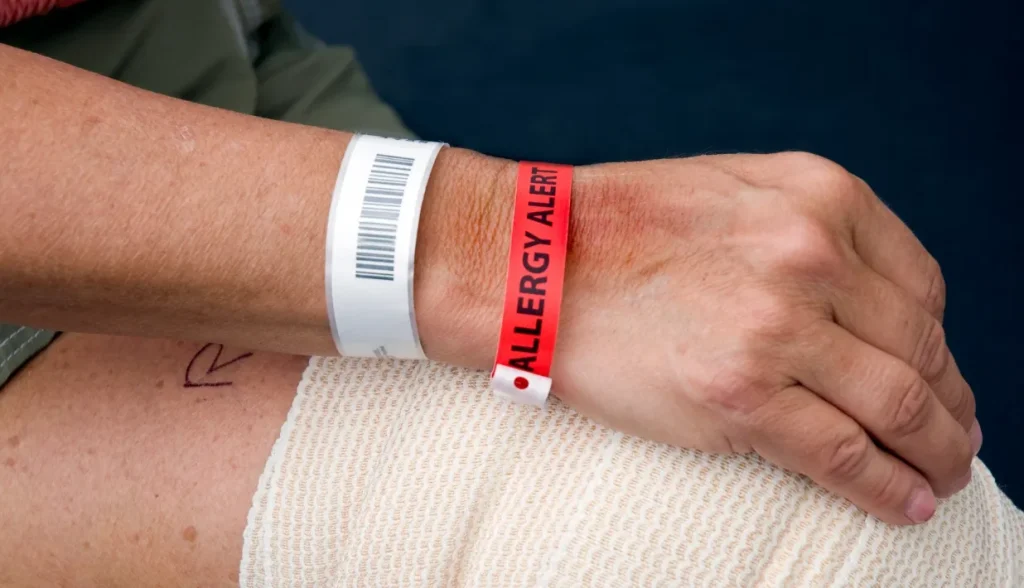
A barcode patient wristband is a widely used identification tool in healthcare settings. It features a unique barcode, either one-dimensional (1D) or two-dimensional (2D), printed directly onto a durable wristband worn by the patient. This technology relies on optical scanners to read the encoded information.
How Barcode Identification Works:
- Data Encoding: Patient-specific data, such as name, medical record number, and date of birth, is encoded into a barcode pattern.
- Printing: The barcode is printed onto a wristband, often at the point of admission.
- Scanning: Healthcare professionals use handheld or fixed scanners to read the barcode. The scanner converts the optical pattern into digital data, which is then transmitted to the hospital’s information system.
Common Barcode Formats:
- 1D Barcodes (e.g., Code 39, Code 128): These are linear barcodes that store data horizontally. They are simple and widely recognized.
- 2D Barcodes (e.g., QR codes, Data Matrix): These barcodes store data both horizontally and vertically, allowing for a greater amount of information to be encoded in a smaller space.
Typical Hospital Applications: Barcode wristbands are integral to various hospital workflows, including:
- Patient Admission: Quickly registering and identifying patients upon arrival.
- Medication Administration:Verifying the right patient and medication before administration.
- Laboratory Specimen Identification: Ensuring accurate labeling and tracking of samples.
- Blood Transfusion Verification: Confirming patient and blood product compatibility to prevent errors.
2. What Is an RFID Patient Wristband?
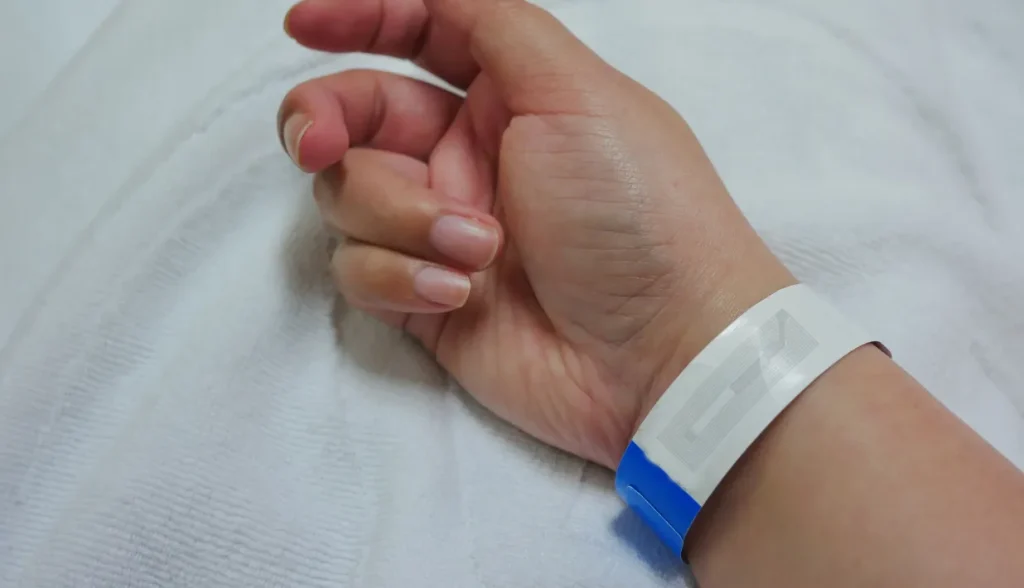
An RFID patient wristband utilizes Radio Frequency Identification technology for automated and contactless patient identification and tracking. Unlike barcodes, RFID does not require a direct line of sight for scanning, offering significant advantages in dynamic healthcare environments.
RFID systems consist of three primary components:
- RFID Wristband: This contains a small microchip and an antenna (the RFID tag) that stores patient data. These tags can be passive (powered by the reader’s radio waves) or active (with their own power source for longer read ranges).
- RFID Reader: Devices that emit radio waves to activate the RFID tag and receive data back from it. Readers can be fixed at doorways, bedsides, or integrated into handheld devices.
- Hospital Information System (HIS/EHR): The central database where the collected RFID data is processed, stored, and integrated with patient records.
Common RFID Frequencies in Healthcare:
- High Frequency (HF) / Near Field Communication (NFC): Typically used for short-range applications, such as patient identification at a bedside or medication verification, where the wristband needs to be close to the reader.
- Ultra-High Frequency (UHF): Offers longer read ranges and faster data transfer, making it suitable for real-time location tracking (RTLS) of patients within a facility, asset tracking, and managing patient flow.
RFID patient wristbands enable a range of advanced applications:
- Automated patient check-in and discharge.
- Real-time tracking of patient location within the hospital.
- Streamlined medication and specimen management.
- Enhanced infant security systems.
- Monitoring patient movement for fall prevention.
- Automated access control to restricted areas.
3. Barcode vs. RFID Patient Wristband: Key Differences
To provide a clear understanding, the following table outlines the key differences between barcode and RFID patient wristband technologies:
| Feature | Barcode Patient Wristband | RFID Patient Wristband |
| Scanning Method | Manual, line-of-sight required | Automatic, no line-of-sight required |
| Speed | Slower, one-by-one scanning | Faster, multiple tags can be read simultaneously |
| Data Storage | Limited data, typically a pointer to a database entry | More data can be stored directly on the tag |
| Cost | Lower initial investment | Higher initial investment |
| Automation | Limited automation, relies on human intervention | High potential for automation and real-time tracking |
| Security | Data is not encrypted on the tag | Can incorporate encryption and authentication features |
4. Advantages of Barcode Patient Wristbands

Barcode patient wristbands have been a staple in healthcare for decades due to several compelling advantages:
- Lower Initial Investment: The cost of barcode printers, scanners, and wristbands is significantly lower compared to RFID systems, making them an attractive option for budget-conscious facilities.
- Easy Implementation: Barcode systems are relatively straightforward to set up and integrate with existing hospital information systems, requiring minimal infrastructure changes.
- Mature and Widely Adopted Technology: Barcode technology is well-established and universally understood, leading to widespread acceptance and ease of use among healthcare staff.
- Suitable for Small Hospitals and Clinics: For smaller facilities with lower patient volumes and simpler workflows, barcode wristbands provide an effective and economical solution for basic patient identification needs.
5. Advantages of RFID Patient Wristbands

RFID patient wristbands offer a leap forward in patient identification and management, providing numerous benefits that address the limitations of barcode technology:
- Faster Patient Identification: RFID readers can scan multiple patient wristbands simultaneously and without direct line of sight, drastically speeding up identification processes.
- No Line-of-Sight Scanning: This allows for greater flexibility and efficiency, as patients do not need to be precisely positioned for scanning, which is particularly beneficial for immobile or unconscious patients.
- Improved Patient Safety: Automated identification reduces the risk of human error in medication administration, specimen collection, and other critical procedures.
- Reduced Medication Errors: By ensuring the right patient receives the right medication at the right time, RFID patient wristbands contribute significantly to medication safety.
- Enhanced Data Security: Modern RFID systems can incorporate encryption and authentication protocols, safeguarding sensitive patient information.
6. Barcode vs. RFID Patient Wristband: Which Is Better for Different Hospital Scenarios
The choice between barcode and RFID patient wristband technology often depends on the specific needs, budget, and operational scale of a healthcare facility. Here’s a recommendation for different hospital scenarios:
| Hospital Scenario | Recommended Technology | Reason |
| Small Clinics | Barcode | Lower budget, simpler workflows, basic identification needs. |
| Community Hospitals | Barcode or RFID | Depends on digital maturity, patient volume, and automation goals. |
| Large Hospitals | RFID | Higher patient volume, complex workflows, need for efficiency and safety. |
| Emergency Departments | RFID | Faster identification, critical for rapid patient processing. |
| Smart Hospitals | RFID | Supports automation, interoperability, and advanced digital initiatives. |
7. Challenges When Switching from Barcode to RFID

Transitioning from barcode to RFID systems, while offering significant benefits, can present several challenges:
- Higher Initial Investment: The upfront cost for RFID infrastructure, including readers, software, and specialized wristbands, is generally higher than for barcode systems.
- System Integration with Existing HIS/EHR: Integrating new RFID systems with legacy Hospital Information Systems (HIS) or Electronic Health Records (EHR) can be complex and require significant IT resources.
- Staff Training: Healthcare personnel will require comprehensive training on new RFID workflows, hardware, and software to ensure smooth adoption and maximize system benefits.
- Reader Deployment Planning: Strategic placement of RFID readers is crucial for optimal performance, requiring careful planning and site surveys to ensure adequate coverage and minimize interference.
- Data Privacy and Security: Implementing robust security measures is paramount to protect sensitive patient data transmitted and stored within the RFID system, addressing concerns about unauthorized access.
- Change Management: Overcoming resistance to change among staff and fostering a culture of adoption are critical for a successful RFID implementation.
Despite these challenges, many hospitals find that the long-term Return on Investment (ROI) from RFID systems is substantial, driven by improved efficiency, reduced identification errors, and enhanced patient safety outcomes.
8. Conclusion
In conclusion, both barcode and RFID technologies play vital roles in patient identification within healthcare. While barcode wristbands remain a practical and cost-effective option for basic identification needs, RFID patient wristbands offer unparalleled efficiency, automation, and enhanced safety for modern healthcare environments.
Hospitals must carefully evaluate their operational needs, budget constraints, and long-term digital transformation goals to select the solution that best supports their commitment to patient care and operational excellence.
RFIDTag offers high-quality RFID wristbands designed for accurate patient identification and seamless system integration. Contact us today to discuss your project or request a sample.






 EN
 ES
 JA