


With the continuous advancement of technology, RFID (Radio Frequency Identification) has been widely applied across various industries. Among these applications, Desktop HF Readers have emerged as efficient and convenient devices that are increasingly becoming important tools in modern access control systems, financial payments, library management, and more. Thanks to their superior performance and versatility, these devices have been extensively deployed in scenarios requiring fast and accurate identification.
Core Features of Desktop HF Readers
High Frequency Operation at 13.56 MHz
Desktop HF readers generally operate at a frequency of 13.56 MHz, a commonly used high-frequency range in RFID technology. This range is advantageous for effective communication over short to medium distances, making it suitable for applications that require high precision and rapid identification. Compared to low-frequency (125 kHz) and ultra-high-frequency (UHF) RFID systems, 13.56 MHz readers possess a stronger anti-interference capability, allowing them to function stably in environments with multiple devices. Therefore, they are widely used by businesses in access management, financial transactions, library management, and more.
Support for ISO 15693 Protocol
Desktop HF Readers support the ISO 15693 protocol, which is an international standard in RFID technology. This protocol enables the devices to operate compatibly with a variety of RFID tags, ensuring their flexibility and scalability. This means that readers adhering to the ISO 15693 protocol can support multiple types of RFID cards or tags simultaneously, fulfilling the needs of various industries and applications. For example, RFID tags identify books in library management and authenticate employees in access control systems.
High Sensitivity Reading Performance
A notable characteristic of HF Readers is their outstanding sensitivity, providing efficient and accurate reading performance in different environments. This high sensitivity enables devices to operate stably in complex working conditions, ensuring quick identification and preventing misreads. In access control or electronic payment settings, readers must handle various physical conditions, such as worn labels on cards. However, the high-sensitivity readers can still effectively read the information.
Anti-Collision Processing Algorithm
Anti-collision technology is another key feature of high-frequency RFID readers. This technology ensures that when multiple tags are present within the reader’s detection range, the reader can effectively distinguish and read each tag’s information. The anti-collision algorithm guarantees that the device operates stably while reading multiple cards, preventing data confusion or read failures. This enables Desktop RFID Readers to provide efficient recognition in high-density scenarios, such as automatic ticketing systems in financial payments and public transportation.
Main Functions of Desktop HF Readers
Reading Distance: Up to 16 cm
Desktop HF Readers typically have a maximum reading distance of 16 cm. This medium-range reading capability is well-suited for various scenarios requiring fast identification. In access control systems, employees need only bring their cards close to the reader to complete identity verification. In library management, the reader can identify books and borrowing cards within a certain range, significantly improving the efficiency of borrowing and returning books.
Multi-Card Reading Functionality
One significant advantage is that Desktop HF Readers support multi-card reading functionality. This enables devices to identify multiple tags simultaneously, enhancing operational efficiency. For locations requiring efficient identity verification, like corporate buildings and public transport systems, the ability to read multiple cards at once dramatically reduces wait times, improving user experience. For instance, in subway systems, readers can simultaneously process multiple passengers’ fare information, cutting down on transit time.
Industry Applications of Desktop HF Readers
Access Control Management
Desktop HF Readers are widely used in access control management systems across various settings, such as enterprises, office buildings, and government agencies. RFID readers verify employee identities, facilitating quick entry and exit management through access cards. With RFID technology supporting contactless identification, employees can smoothly pass through access points without stopping, enhancing operational efficiency and minimizing contact and wait times.
Financial Payments and Electronic Tickets
RFID technology has also found extensive application in financial payments and electronic ticketing. In premium payment systems, RFID readers quickly read card information to support contactless payment. Additionally, RFID technology is widely implemented in electronic tickets, such as e-tickets for trains and planes, improving travel efficiency for passengers. For example, RFID readers at airport security checks and train station ticket gates can swiftly verify passengers’ electronic tickets, avoiding the tedious processes associated with traditional manual ticket checking.
Library Management
In library management systems, Desktop HF Readers provide a more efficient solution for book management. By installing RFID tags on books, libraries can quickly scan and record borrowing and returning information, eliminating traditional manual processes and improving management efficiency. Readers need only place books near self-checkout machines, and the RFID reader will automatically complete the borrowing or returning process, greatly enhancing the borrowing experience.
Other Industry Applications
The applications of Desktop RFID Readers extend beyond access control, payment, and library management; they are also widely utilized in logistics management, retail, healthcare, and other sectors. For instance, in retail, RFID technology can enable rapid stocktaking and inventory management; in healthcare, RFID readers can assist in managing patient information, ensuring effective tracking of medical equipment and supplies.
Conclusion and Outlook
Desktop HF Readers, with their high-frequency operation at 13.56 MHz, ISO 15693 protocol support, excellent reading performance, and anti-collision processing algorithms, have become indispensable tools across multiple industries. As RFID technology continues to evolve and application scenarios expand, the prospects for Desktop HF Readers are very promising. They not only enhance the efficiency of existing systems but can also deeply integrate with other advanced technologies such as IoT and artificial intelligence, driving industries toward more intelligent and automated directions.
With the ongoing advancements in RFID technology, we can foresee Desktop RFID Readers playing a vital role in even more fields in the future, enhancing our work efficiency and quality of life.
FAQs
What Unique Advantages Do Desktop HF RFID Readers Offer in Their Application Scenarios?
Desktop HF RFID readers stand out due to their contactless identification capabilities, allowing for the efficient reading of tags in very short times. They can also read multiple cards simultaneously, making them suitable for high-density and high-traffic environments. This unique feature drives their widespread use in access control systems, public transportation, financial payments, and library management, significantly enhancing management efficiency and user experience.
Why Are Desktop HF RFID Readers Suitable for Simultaneously Reading Multiple Cards?
Desktop HF RFID readers use anti-collision technology to identify several cards at once. When multiple cards enter the reader’s detection range, the anti-collision algorithm processes them automatically, ensuring accurate data reading from each card. This functionality is particularly critical in high-density scenarios, such as airports, subways, and corporate buildings, where it significantly boosts reading speed and reduces wait times.
What Impact Does the ISO 15693 Protocol Have on Desktop HF RFID Readers?
The ISO 15693 protocol is an international standard that ensures desktop HF RFID readers can be compatible with various brands and types of RFID tags. By supporting the ISO 15693 protocol, readers can flexibly meet diverse industry needs, offering a range of solutions. Whether in access control, payment processing, or library management, the ISO 15693 protocol enhances device compatibility and stability.
Recommended Product
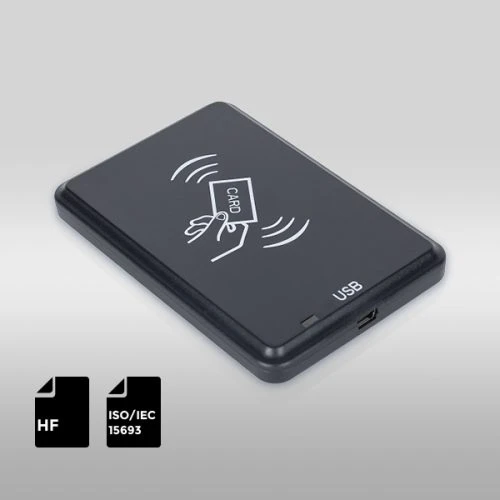
Desktop HF ISO 15693 RFID Reader / Writer AZ-RL173
The HF RFID Desktop Reader is designed for precision desktop RFID reading and data writing under ISO/IEC 15693. This compact device offers stable high-sensitivity performance and fast anti-collision processing, making the HF RFID Desktop Reader ideal for libraries, secure access control, finance, ticketing, and smart inventory tasks. Its plug-and-play design allows smooth integration into any desktop workspace. With this HF RFID Desktop Reader, companies can streamline data workflows, reduce human errors, and boost asset visibility. Fully compliant with the ISO15693 protocol, it ensures compatibility with standard HF RFID tags used globally.

 EN
 ES
 JA