


The advent of the Digital Product Passport for textiles marks a pivotal shift in the industry’s approach to sustainability and transparency. This initiative, primarily driven by stringent EU regulations, mandates a comprehensive digital record for textile products, detailing their journey from raw material to end-of-life. While many brands initially consider QR codes as a straightforward solution, the true essence of the Digital Product Passport extends far beyond simple consumer scanning, demanding robust lifecycle data collection that QR codes struggle to support at scale. This is where RFID becomes the real game changer.
1. What Data a Textile Digital Product Passport Must Contain

A comprehensive Digital Product Passport for textiles is designed to capture a vast array of information across a product’s entire lifecycle. This includes, but is not limited to:
- Fiber composition, origin, and manufacturing data: Detailed breakdown of materials used, their geographical origin, and key manufacturing processes.
- Logistics history: Records of transportation, warehousing, and distribution.
- Retail lifecycle data: Information related to sales, stock movements, and product availability.
- Repair, resale, and recycling information: Guidelines for product longevity, authentication for secondary markets, and instructions for proper end-of-life processing.
The critical requirement is for continuous data updates, ensuring the passport remains a dynamic and accurate reflection of the product’s status throughout its existence.
2. Why QR Codes Cannot Support Textile DPP at Scale

Despite their widespread use and apparent simplicity, QR codes present significant limitations when it comes to implementing a scalable Digital Product Passport for textiles system:
- Washed out / damaged care labels: QR codes printed on care labels are highly susceptible to damage from washing, wear, and tear, rendering them unreadable.
- Manual scanning dependency: Each QR code requires individual, line-of-sight scanning, making bulk processing in warehouses or sorting facilities impractical and time-consuming.
- Impossible for warehouse bulk reading: The need for manual scanning prevents efficient inventory management and automated data capture in large-scale operations.
- Easy to copy and tamper: QR codes can be easily replicated or altered, raising concerns about data integrity and product authenticity.
- No automation in supply chain data capture: The reliance on manual interaction means QR codes offer minimal automation for capturing data as products move through the supply chain.
3. Why RFID Fits the True Requirement of Digital Product Passport

Radio-Frequency Identification (RFID) technology offers a compelling solution that aligns perfectly with the advanced requirements of the Digital Product Passport for textiles:
- RFID as a physical data carrier: RFID tags can store a unique identifier linked to a comprehensive digital record.
- Non-line-of-sight, bulk reading: RFID readers can scan multiple tags simultaneously without direct line of sight, revolutionizing inventory management and logistics.
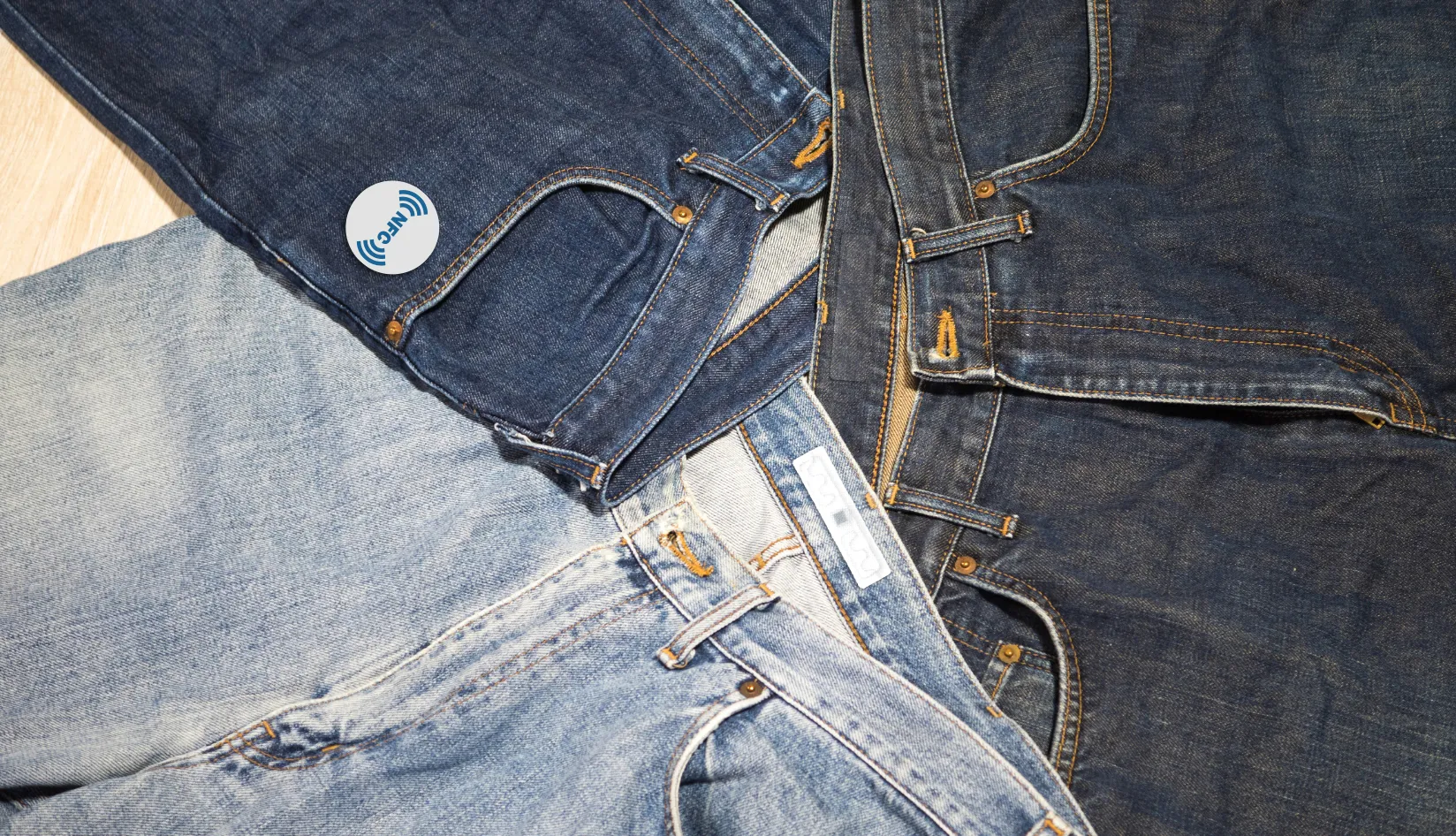
- Hidden inside care labels / woven labels: RFID tags can be discreetly integrated into product labels, making them less prone to damage and tampering.
- Durable through washing and lifecycle: Designed to withstand harsh conditions, RFID tags maintain functionality throughout a product’s lifespan, including multiple washes.
- Tamper-resistant unique ID: Each RFID tag carries a unique, secure identifier, significantly enhancing product authenticity and traceability.
4. Step-by-Step: How RFID Enables DPP Across the Textile Lifecycle

RFID technology seamlessly integrates into various stages of the textile lifecycle, enabling robust data collection for the Digital Product Passport:
4.1 Raw Material & Manufacturing Stage
- Tagging at source: RFID tags are applied to raw materials or components at the earliest possible stage.
- Linking production data to EPC / chip ID: Detailed production information, including fiber composition and origin, is linked to the unique Electronic Product Code (EPC) or chip ID of each tag.
4.2 Warehouse & Logistics
- Automatic bulk scanning: Products equipped with RFID tags can be scanned in bulk as they enter or exit warehouses, significantly speeding up receiving and dispatch processes.
- Inventory movements automatically logged into DPP database: Every movement is automatically recorded, providing real-time visibility and accurate inventory data for the Digital Product Passport.
4.3 Retail Store Operations
- Stock accuracy: RFID enables near-perfect inventory accuracy, reducing stockouts and overstocking.
- Sales event linked to product ID: When an item is sold, its unique RFID is scanned, automatically updating its status within the DPP system.
4.4 Consumer Use, Return, and Resale
- Identification for resale platforms: RFID tags facilitate easy identification and authentication for products entering the secondary market.
- Authentication: The unique ID helps verify product authenticity, combating counterfeiting.
4.5 Recycling & Circular Economy
At end-of-life, automated sorting facilities can instantly read RFID tags to identify material composition, enabling efficient recycling and promoting circularity.
5. Brands Already Doing What DPP Requires — Using RFID
Long before Digital Product Passport regulations emerged, several global apparel brands had already built the exact infrastructure DPP now requires — through RFID.
- Zara embeds RFID in garment labels at manufacturing. Every item is automatically tracked from factory to store to point of sale, creating continuous lifecycle records without manual scanning.
- Decathlon uses RFID across warehouses and stores for bulk reading, instant inventory, and product traceability — exactly the type of automated data capture DPP depends on.
- Uniqlo and H&M adopted RFID to improve operations, yet the result is that every garment already carries a persistent, machine-readable identity throughout its lifecycle.
These brands did not implement RFID for compliance. They did it for efficiency. But in doing so, they have quietly demonstrated how Digital Product Passport for textiles can work at scale in the real world.
6. RFID vs QR for Digital Product Passport in Textiles
| Feature | QR Code | RFID |
| Cost (initial) | Lower | Higher |
| Scanning Method | Line-of-sight, manual | Non-line-of-sight, automated, bulk |
| Durability | Low (prone to damage/wear) | High (durable through washing/lifecycle) |
| Bulk Reading | Impossible | Highly efficient |
| Data Capacity | Limited (URL link) | Higher (unique ID linked to database) |
| Tamper Resistance | Low (easy to copy) | High (secure, unique ID) |
| Automation Potential | Low | High |
| Supply Chain Visibility | Limited | Comprehensive, real-time |
7. Why Apparel Brands Are Quietly Moving Toward RFID for DPP Compliance

The shift towards RFID for Digital Product Passport for textiles compliance is driven by a confluence of factors:
- Compliance pressure: The impending EU regulations make robust traceability solutions non-negotiable.
- Operational benefits beyond compliance: RFID offers significant advantages in inventory accuracy, supply chain efficiency, and loss prevention, providing a strong business case beyond mere regulatory adherence.
- RFID already used for inventory — natural extension to DPP: Many large brands have already invested in RFID for inventory management, making its extension to support DPP a logical and cost-effective step.
8. The Future: RFID-Enabled Digital Product Passport as the Standard for Garments
The trajectory is clear: RFID woven into care labels will become the standard for garments. While QR codes may continue to serve as a consumer-facing interface for basic information, RFID will underpin the operational backbone of the Digital Product Passport. This convergence of compliance and efficiency will transform how the textile industry manages its products, making true circularity a tangible reality. Without RFID, the vision of a comprehensive Digital Product Passport for textiles remains largely theoretical; with it, it becomes a practical, scalable system for the entire textile ecosystem.
9. Conclusion
Digital Product Passport for textiles demands more than a digital record. It requires a physical link between a garment and its evolving data history. QR codes help with transparency. But only RFID enables the automated, lifecycle data capture that DPP regulations truly require. As compliance deadlines approach and circular fashion becomes mainstream, RFID will move from an operational tool to a regulatory necessity embedded inside every garment.
Explore reliable RFID tags designed for textile labels and lifecycle traceability. Visit our website to find the right RFID solution for your Digital Product Passport projects.
Recommended Product

NXP UCODE® 9 Textile RFID Laundry Tag
The UHF RFID Laundry Tag Textile NXP UCODE® 9 combines an ultra-thin textile design with powerful UHF performance, enduring over 200 industrial washes and up to 60 Bars of pressure. Perfect for intensive washing environments in healthcare, hospitality, and linen rental, it ensures stable, reusable, and eco-compatible textile tracking.



 EN
 ES
 JA