


In busy warehouses and production environments, finding the right item quickly can be just as important as identifying it accurately. RFID LED tags combine RFID-based identification with a visible LED indicator, helping workers locate and visually confirm tagged items faster. This combination can streamline item picking, reduce identification errors, and improve verification during daily operations.
1. What Are RFID LED Tags
RFID LED tags are RFID tags equipped with an integrated LED light. Like conventional RFID tags, they communicate with RFID readers and provide a unique identification number for the tagged item. The difference is that an RFID LED tag can also provide a visual indication when activated by the RFID system.
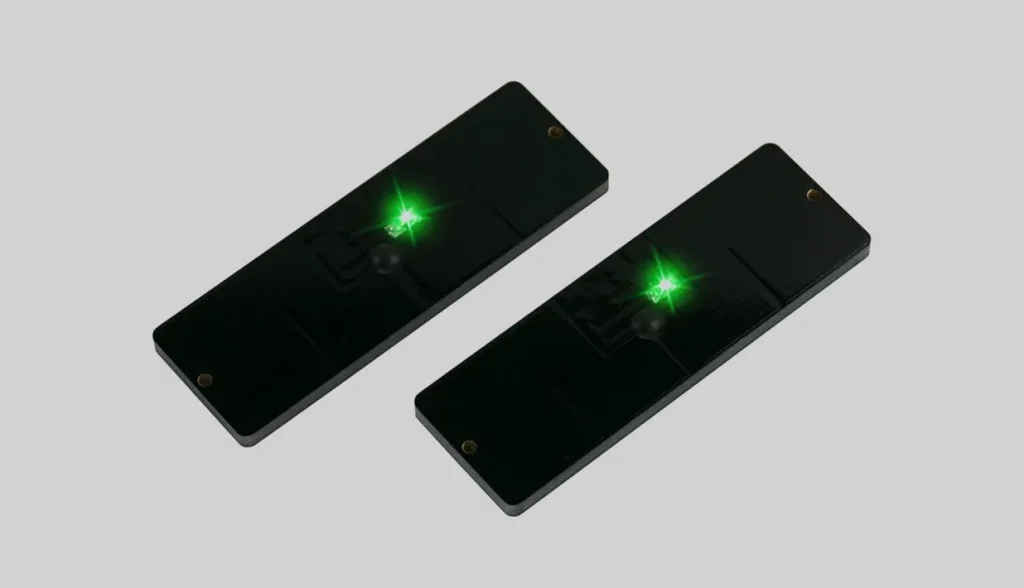
This makes RFID LED tags particularly useful when workers need to identify one specific item among many tagged products or assets.
An RFID LED tag therefore combines two functions:
- RFID identification: Provides automated and contactless item identification.
- LED indication: Provides a visible signal for locating or confirming the target item.
This combination is especially useful in environments where items are densely stored or visually difficult to distinguish.
2. How Do RFID LED Tags Work
An RFID LED solution typically consists of an RFID tag with an integrated LED, an RFID reader, and software that manages the identification process.
The basic workflow is:
The system identifies the target item.
The warehouse or management system determines which item needs to be picked, located, or verified.
The RFID reader communicates with the tag.
The reader sends a radio-frequency signal and identifies the corresponding RFID tag.
The LED is activated.
After the target tag is identified, the integrated LED provides a visual indication.
The worker locates the item.
Instead of searching through similar items manually, the worker can follow the visual cue to identify the target.
The item is picked or verified.
The worker confirms the correct item before completing the next step of the workflow.
3. How RFID LED Tags Improve Item Picking
Item picking is one of the areas where visual identification can provide a practical advantage. In a conventional RFID workflow, the system can identify that a target tag is present within the reader’s range. However, when multiple tagged items are close together, the worker may still need to determine which physical item corresponds to the identified tag. An RFID LED tag adds a visual layer to this process.

3.1 Faster Item Location
Workers can use the illuminated tag as a visual reference when searching for a specific item.
This is particularly useful in:
- High-density warehouse shelving
- Parts storage areas
- Manufacturing workstations
- Equipment storage areas
3.2 Reduced Picking Errors
Picking errors can occur when products have similar appearances, SKUs, packaging, or storage locations. RFID provides electronic identification, while the LED provides visual confirmation. Together, they create an additional verification point before an item is picked.
This can help reduce mistakes such as:
- Selecting the wrong SKU
- Picking the wrong quantity
- Choosing a similar-looking component
- Selecting an item from the wrong storage location
3.3 Less Manual Searching
Traditional picking often depends heavily on workers visually searching shelves or checking labels. RFID LED technology can reduce the amount of manual searching required by guiding workers toward the target item. This can be particularly valuable when the same type of product is stored in large quantities.
3.4 Faster Order Fulfillment
When workers can identify target items more quickly, individual picking tasks can take less time. For high-volume operations, even small improvements in picking speed can accumulate into meaningful productivity gains across an entire shift.
4. RFID LED Tags for Item Verification
Item picking is only one application. RFID LED tags can also support item verification.
Verification is important when a business needs to confirm that the correct item has been selected, processed, inspected, or moved to the next stage.
For example, an RFID LED system can be used to:
- Confirm that the correct component has been selected
- Verify items before shipment
- Identify products during sorting
- Confirm equipment during inspection
- Verify items at a workstation
5. RFID LED Tags vs. Standard RFID Tags
Standard RFID tags are highly effective for automated identification and tracking. However, they do not normally provide a built-in visual signal to help workers identify a specific physical item.
The main difference can be summarized as follows:
| Feature | Standard RFID Tag | RFID LED Tag |
| RFID identification | ✓ | ✓ |
| Contactless reading | ✓ | ✓ |
| Automated data collection | ✓ | ✓ |
| Visual indication | — | ✓ |
| Item locating | Good | Enhanced |
| Picking assistance | Limited | Strong |
| Visual verification | Limited | Enhanced |
This does not mean RFID LED tags should replace standard RFID tags in every application. If an application only requires automated identification and inventory data collection, a conventional RFID tag may be sufficient.
6. Where Can RFID LED Tags Be Used
The combination of RFID identification and visual indication makes RFID LED tags suitable for a range of operational environments.
6.1 Warehouses and Distribution Centers

In warehouses, RFID LED tags can help workers locate inventory items during picking and sorting. They can be particularly useful in high-density storage environments where multiple similar items are stored close together.
6.2 Manufacturing
Manufacturers can use RFID LED tags to identify components, work-in-process items, or equipment at different production stages. The LED can provide a visual indication when a specific component or asset needs to be selected or processed.
6.3 Equipment and Tool Management
For tool rooms and equipment storage areas, RFID LED tags can help workers locate a specific tool or piece of equipment without manually checking every item. This can improve retrieval efficiency when many similar tools are stored together.
6.4 Logistics and Sorting
During sorting and distribution processes, an illuminated RFID LED tag can provide a visual cue for identifying the intended item, helping workers process tagged goods more efficiently.
7. Key Factors to Consider When Choosing RFID LED Tags
Not every RFID LED tag is suitable for every application. Before selecting a product, consider the following factors.
7.1 RFID Frequency
UHF RFID is commonly used when longer read ranges and fast identification of multiple tags are required. Check that the tag’s frequency range is compatible with your RFID reader and regional requirements.
7.2 LED Visibility
The LED should be sufficiently visible for the working environment.
Consider factors such as:
- Viewing distance
- Lighting conditions
- Tag position
- LED brightness
- Required activation duration
A clear visual signal is essential if the main purpose of the LED is to assist workers during picking or verification.
7.3 Installation Surface
The mounting surface can significantly affect RFID performance. For applications involving metal equipment, racks, containers, or machinery, choose an on-metal RFID LED tag designed specifically for metallic surfaces.
8. Conclusion
RFID LED tags combine automated RFID identification with visual guidance, helping workers locate, pick, and verify specific items more efficiently. They are especially useful in warehouses, manufacturing, logistics, and other environments where similar items are stored or processed in high volumes.
If your application requires both reliable RFID identification and visual item confirmation, RFIDTag can provide RFID LED tags in different designs and configurations to meet your operational requirements. Contact us or visit our website to discuss your application and request a suitable sample.





 EN
 ES
 JA