


In the dynamic world of retail technology, the implementation of RFID tag decathlon stands out as a benchmark for operational excellence. As a global sporting goods giant, Decathlon has masterfully leveraged RFID technology to revolutionize its inventory management, setting a new industry standard. This blog post explores how RFID tags serve as the fundamental enabler behind Decathlon’s remarkable achievement of near-perfect inventory accuracy, transforming their entire supply chain from manufacturing to checkout.
1. The Inventory Problem in Apparel Retail Before RFID

Before RFID, apparel retail relied almost entirely on barcodes. Barcodes are inexpensive and universal, but they are fundamentally line-of-sight, one-by-one identification tools. That limitation created systemic problems:
- Manual cycle counts took hours or days
- Human error in scanning and counting was common
- Stock records were often 70–85% accurate at best
- Out-of-stocks occurred even when items were physically in the store
- Shrinkage and misplacement were hard to detect in time
In large-format stores with thousands of SKUs and constant replenishment, barcode processes simply could not provide real-time truth. The result was a gap between system inventory and physical inventory—a gap that directly translated into lost sales.
2. When and Why Decathlon Adopted RFID Tags
Decathlon, recognizing the limitations of traditional inventory methods and the burgeoning potential of RFID, embarked on a pioneering journey to integrate RFID technology into its global operations. Their adoption of RFID tag decathlon practices began in the early 2010s, marking one of the earliest and most ambitious large-scale implementations of item-level RFID in the retail sector.

The decision to embrace RFID was driven by a clear understanding that simply refining existing barcode workflows would not yield the transformative results required. Barcodes, by their nature, necessitate line-of-sight scanning and individual item handling, which inherently limits speed and introduces opportunities for human error. Decathlon sought a solution that could enable rapid, bulk scanning and provide real-time data feeds, thereby eliminating the bottlenecks associated with manual processes. RFID offered this capability, promising to drastically reduce the time spent on inventory counts and improve the reliability of stock data.
3. Where RFID Tags Are Placed on Decathlon Products
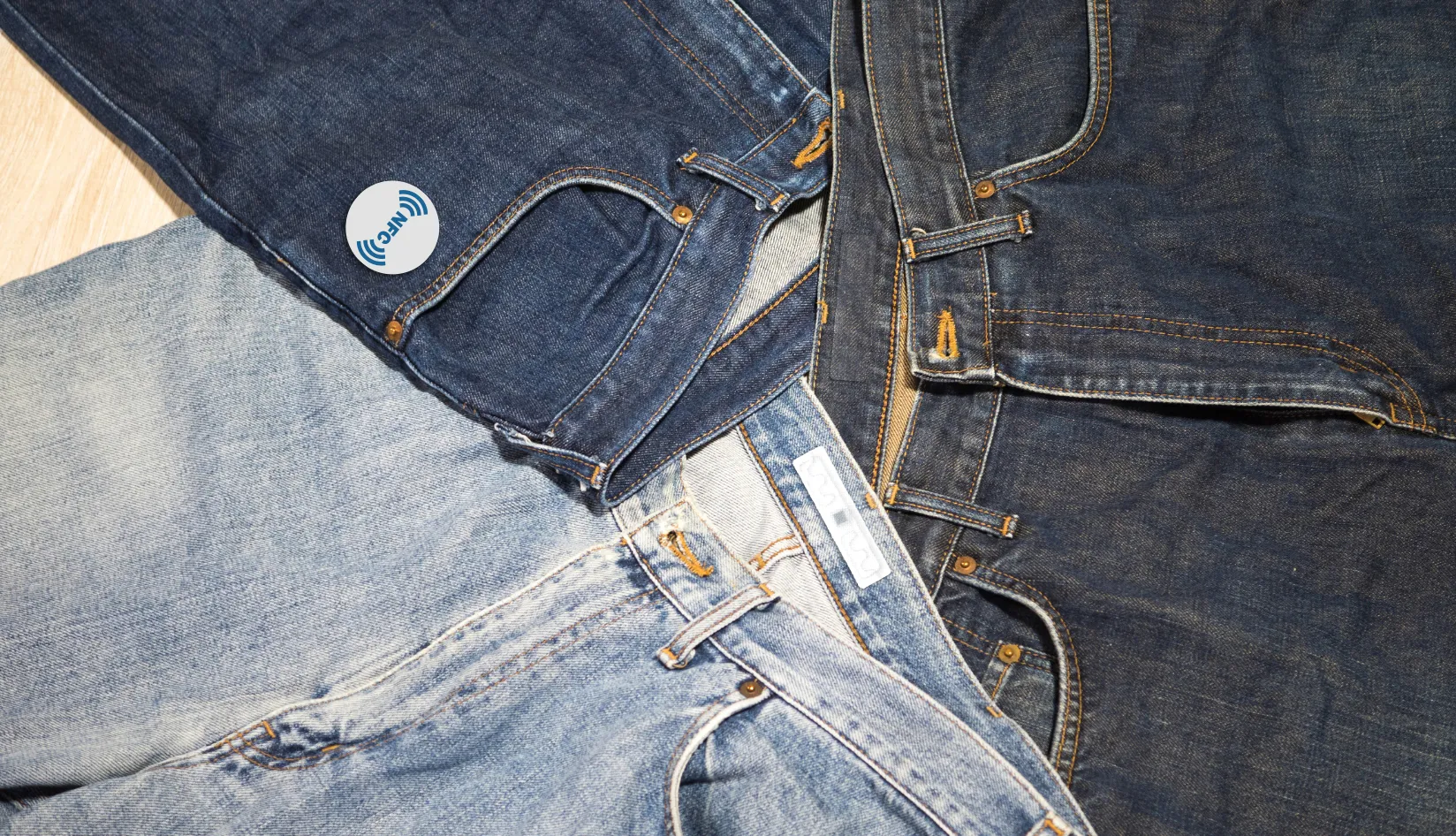
A key detail often overlooked is tag placement. Decathlon did not add RFID as a separate device. Instead, the RFID inlay is integrated directly into:
- Apparel hang tags
- Product labels
- Packaging tags for soft goods

This approach preserves aesthetics and cost efficiency while ensuring every item is RFID-enabled without additional handling.
Most importantly, tagging happens at the factory, not at the store or distribution center. Each item leaves production already encoded with a unique EPC (Electronic Product Code). From that moment on, the product is digitally visible.
4. How RFID Tags Work Across Decathlon’s Entire Workflow
The RFID tag decathlon approach ensures that data is captured and utilized from the moment a product is manufactured until it leaves the store.
4.1 At Manufacturing
At the manufacturing stage, the journey of each Decathlon product begins with the encoding and application of its unique RFID tag. Each product receives an EPC that uniquely identifies it, distinguishing it from every other identical item. This process is typically automated, ensuring high accuracy and efficiency. By embedding the RFID tag during production, Decathlon ensures that every item is ‘born’ with its digital identity, ready for tracking and management even before it is packed. This proactive tagging eliminates the need for later, more costly, and less efficient tagging processes at distribution centers or stores.

4.2 At Distribution Centers
When cartons arrive at distribution centers, staff do not open boxes to count items. Instead, RFID readers scan entire cartons in seconds. The system verifies:
- Whether the shipment is correct
- Whether any items are missing
- Whether extra items are present
Receiving errors that previously took hours to detect are now caught instantly.
4.3 In Retail Stores
Within Decathlon’s retail stores, RFID technology revolutionizes inventory management. Store associates utilize handheld RFID readers to perform cycle counts with unprecedented speed and accuracy. What once took hours or even days with barcode scanning can now be accomplished in minutes.
A typical store inventory check can be completed daily, providing shelf-level visibility and ensuring that products are always available where customers expect them to be. This frequent and rapid inventory auditing drastically reduces out-of-stock situations, improves product availability, and frees up staff to focus on customer service rather than manual stock-taking. The ability to quickly locate misplaced items also enhances operational efficiency and customer satisfaction.
4.4 At Checkout
At checkout, multiple items are scanned simultaneously without line-of-sight. This speeds up transactions and ensures the system inventory updates instantly when items leave the store.
5. The Technology Behind the RFID Tags Decathlon Uses
The tags used follow the UHF Gen2 (RAIN RFID) standard, which enables:
- Long read range (several meters)
- Anti-collision reading of hundreds of tags at once
- Fast data transmission
- Low cost suitable for disposable apparel tags
But the standard alone is not enough. Tag performance depends on:
- Antenna design optimized for fabric environments
- Stable chip performance in dense tag populations
- Proper encoding structure in EPC memory
- Tag flexibility and durability
In large deployments, tag quality determines read rate, and read rate determines whether the system can be trusted.
6. The Measurable Results Decathlon Achieved
Decathlon’s commitment to RFID technology has yielded quantifiable and transformative results, solidifying its position as a leader in retail operational efficiency. The most significant achievement is the dramatic improvement in inventory accuracy, which now consistently approaches an impressive 98-99%.

This near-perfect accuracy has a cascading effect across the entire business:
- Drastic Reduction in Time Spent on Stock Counts: This efficiency frees up store associates to focus on customer engagement and sales, rather than back-office tasks.
- Fewer Out-of-Stock Situations: With real-time, accurate inventory data, Decathlon can precisely monitor stock levels and replenish products proactively.
- Improved Replenishment Speed: Products can be moved from distribution centers to stores, and from backrooms to sales floors, much faster, ensuring optimal stock levels at all times.
- Lower Shrinkage and Better Loss Detection: Item-level tracking makes it far easier to identify discrepancies and pinpoint where losses occur, whether due to theft, administrative errors, or damage. This granular data empowers Decathlon to implement more effective loss prevention strategies, safeguarding profitability.
7. Why RFID Tags Are the Real Foundation
Decathlon’s experience underscores the importance of stable, retail-grade RFID tags that are designed for the specific challenges of the apparel environment. Factors such as tag antenna design, chip performance, and durability against environmental stressors are critical. The hidden role of tag design in overall project success cannot be overstated.
8. Can Other Retailers Replicate Decathlon’s RFID Model
Can other retailers, particularly those in the apparel sector, replicate this model? The answer is yes, but it requires a comprehensive understanding of the foundational elements and a commitment to strategic implementation.

- Item-Level Tagging: The ability to uniquely identify and track every single product from its origin is the cornerstone of high inventory accuracy. This often means working closely with manufacturers to integrate tagging into the production process.
- Process Redesign: This includes adapting workflows in manufacturing, distribution centers, and retail stores to leverage the speed and accuracy of RFID.
- Reader Infrastructure: A robust network of RFID readers is essential to capture data efficiently across the supply chain.
9. Conclusion
The reason so many industry professionals search for RFID tags in Decathlon is that it represents a proven blueprint for apparel retail transformation. Decathlon demonstrated that when RFID tags are integrated at the source, optimized for apparel, and supported by redesigned store processes, inventory accuracy can approach perfection at massive scale.
Looking for the right RFID tag solution? Visit RFIDTag to find tailored solutions for your business needs.
Recommended Product

Impinj® Monza® 4QT Silicone RFID Laundry Tag
The Impinj® Monza® 4QT Silicone RFID Laundry Tag combines flexible silicone material with robust UHF performance, ensuring excellent readability through harsh laundry processes. Trusted by hospitality and healthcare industries, it streamlines linen tracking, inventory control, and garment lifecycle management with long-lasting durability and consistent results.



 EN
 ES
 JA