
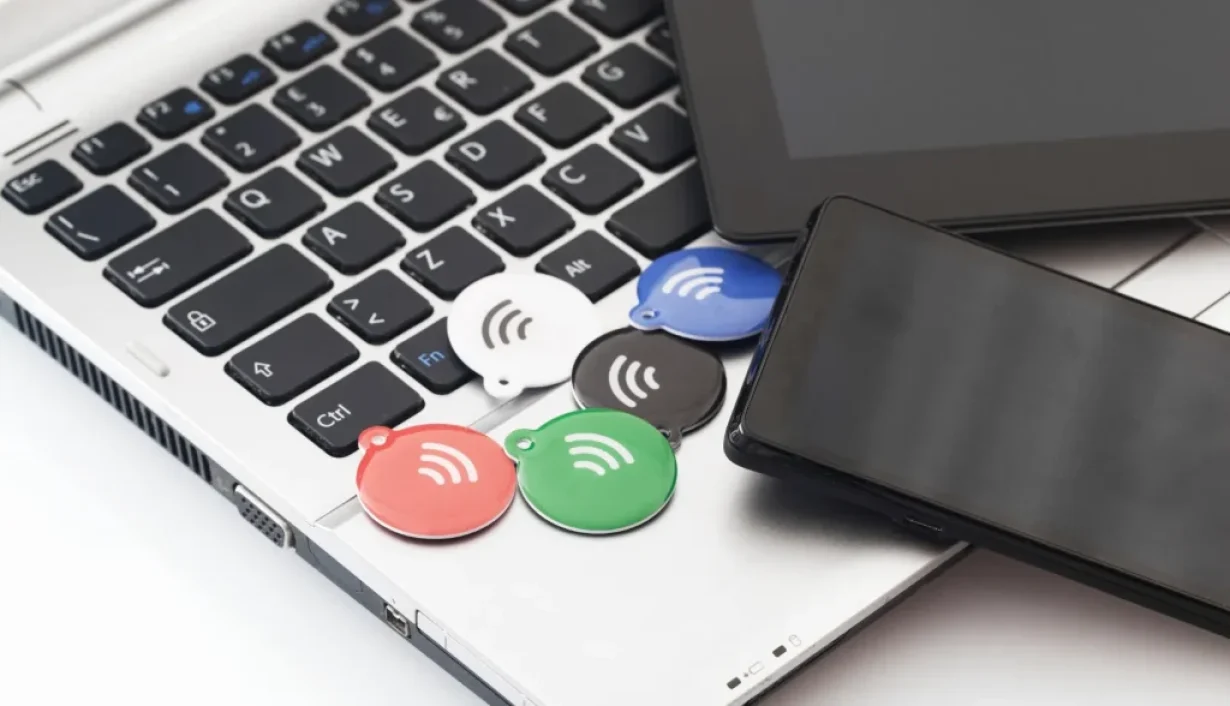

Selecting the right Near Field Communication (NFC) hardware is a critical step in ensuring a seamless user experience. One of the most common questions for developers and product managers is how NFC tag dimensions impact the effective scanning distance. While the technology operates on simple electromagnetic principles, the interplay between size and performance is nuanced. This article explores the direct relationship between tag size and read range, helping you optimize your next project for the international market.
1. What Determines NFC Read Range?
Unlike UHF RFID, NFC operates at 13.56 MHz and relies on near-field magnetic coupling between the reader and the tag. This means communication happens only when the reader and tag are physically close to each other.

Several factors affect NFC read range:
- Antenna size
- Antenna design
- NFC chip sensitivity
- Reader power
- Metal interference
- Environmental conditions
- Tag orientation
Among these factors, antenna size is one of the most important. Since antenna size is closely related to NFC tag dimensions, the overall dimensions of the tag have a major impact on performance.
2. Understanding the Basics of NFC Tag Dimensions
To understand the relationship between size and range, we must first distinguish between the physical size of the tag and the size of its internal antenna. An NFC tag typically consists of an IC (Integrated Circuit) and an antenna, often housed on a substrate like PET or paper.

When we discuss NFC tag dimensions, we are often referring to the outer measurements of the sticker or card. However, the true driver of performance is the antenna size. A high-quality tag will maximize the antenna surface area within the given physical footprint. For example:
- Wet Inlays: These are the functional part of the tag, where the antenna is visible.
- White Labels: These add a paper or plastic face, often resulting in a slightly larger physical size than the antenna itself.
- Encapsulated Tags: Disc tags or keyfobs have thicker housing, which can add bulk without increasing the antenna’s reach.
3. How Size Affects the Magnetic Field
NFC operates on the principle of inductive coupling at a frequency of 13.56 MHz. The reader (such as a smartphone) creates a magnetic field. When an NFC tag enters this field, the antenna harvests energy through electromagnetic induction to power the chip and transmit data.

The efficiency of this energy harvest is directly proportional to the antenna’s surface area. A larger antenna acts like a larger “net,” catching more magnetic flux from the reader. Consequently:
- Increased Flux Capture: Larger NFC tag dimensions allow the antenna to capture more energy at a greater distance.
- Mutual Inductance: The coupling between the reader and the tag is strongest when their antennas are of similar size and alignment.
- Power Threshold: Every NFC chip has a minimum power requirement. Larger antennas reach this threshold further away from the reader than smaller ones.
4. Small vs. Large: Comparing Common NFC Tag Dimensions
The market offers a vast array of sizes, each suited for different use cases. Understanding the trade-offs is essential for product design.

4.1 Small Tags (Under 20mm)
Small tags are popular for discreet integration into jewelry, medical devices, or small consumer electronics. However, they come with significant performance limitations.
- Read Range: Typically 5mm to 15mm.
- User Experience: Requires very precise placement.
- Best For: Applications where space is extremely limited and the user is expected to touch the device directly.
4.2 Medium Tags (25mm to 40mm)
This is the “goldilocks” zone for most commercial applications. A 30mm round tag is the industry standard for marketing stickers and product packaging.
- Read Range: Typically 20mm to 40mm.
- User Experience: Offers a reliable “tap and go” feel. Most smartphones can easily detect these tags without requiring surgical precision.
- Best For: Retail, smart packaging, and interactive posters.
4.3 Large Tags (Credit Card Size and Above)
When maximum range is required, larger NFC tag dimensions are the way to go. These are often used in corporate ID badges or smart posters.
- Read Range: Can reach 50mm to 70mm or more depending on the reader’s power.
- User Experience: Extremely forgiving. The tag can often be scanned even before it physically touches the reader.
- Best For: Access control, transit cards, and large-scale advertising.
5. Factors That Complicate the Size-Range Relationship
While “bigger is generally better,” the relationship is not always linear. Several technical factors can influence how NFC tag dimensions translate into real-world performance.

5.1 The Reader’s Antenna Size
Maximum efficiency occurs when the tag antenna matches the reader antenna. Most modern smartphones have NFC antennas located near the top edge or around the camera module. If a tag is significantly larger than the phone’s antenna, the magnetic field may not be uniform across the entire tag, leading to diminishing returns in range.
5.2 Chip Sensitivity and Power Requirements
Not all NFC chips are created equal. Newer generations, like the NXP NTAG213 or ICODE series, are designed for higher sensitivity. A high-sensitivity chip on a medium-sized antenna might outperform a low-sensitivity chip on a larger antenna. Additionally, chips with complex features like AES encryption require more power, which naturally reduces their effective read range.
5.3 Environmental Interference
Metal is the enemy of NFC. If a tag is placed on a metal surface, the magnetic field is “shorted out,” rendering the tag unreadable regardless of its size. In these cases, you must use “on-metal” tags, which include a ferrite shielding layer. These layers add thickness and can slightly alter the optimal NFC tag dimensions for the intended range.
6. Practical Guide: Choosing the Right Dimensions for Your Application
To select the ideal NFC tag dimensions, follow this decision-making framework:
- Identify Environment: Will they be scanning in a stable environment (like a desk) or on the move (like a bus stop)? For “on-the-go” scanning, prioritize larger antennas (35mm+).
- Determine the Housing Material: If the tag is buried inside plastic or glass, the material will attenuate the signal. You may need to increase the antenna size to compensate for the loss.
- Balance Aesthetics and Function: While a 50mm sticker offers great range, it might overwhelm your product’s design. A 30mm tag often provides the best balance of visibility and performance.
| Application | Recommended Size | Expected Range |
| Jewelry/Wearables | 10mm – 15mm | 0 – 1 cm |
| Product Packaging | 25mm – 30mm | 2 – 4 cm |
| Smart Posters | 40mm – 50mm | 4 – 6 cm |
| Access Control Cards | 85mm x 54mm | 5 – 8 cm |
7. Antenna Design Matters as Much as Size
Although NFC tag dimensions strongly influence read range, dimensions alone do not determine performance.

Two tags with identical sizes may perform differently because of:
- Antenna geometry
- Coil turns
- Copper quality
- Chip sensitivity
- Matching circuit optimization
A well-designed 20 mm NFC tag can sometimes outperform a poorly designed 25 mm tag. This is why professional NFC manufacturers focus not only on dimensions but also on antenna engineering and tuning.
8. Conclusion
The relationship between NFC tag dimensions and read range is one of the most important considerations in NFC system design. In general, larger NFC tag dimensions allow for larger antennas, stronger magnetic coupling, and more reliable scanning performance. However, dimensions alone are not enough. Antenna design, materials, installation surface, and smartphone compatibility all influence real-world results.
At RFIDTag, we provide customized NFC tags for packaging, industrial tracking, smart marketing, and IoT applications. Whether you need small NFC tags or high-performance anti-metal solutions, our team can help you select the right dimensions for your project.
FAQs
1. Does a larger NFC tag always have a longer read range?
Generally, yes. Larger NFC tag dimensions allow for larger antennas, which usually improve magnetic coupling and scanning distance. However, antenna design and chip sensitivity also affect performance.
2. What is the smallest workable NFC tag size?
Some ultra-small NFC tags can be as small as 8–10 mm. However, very small tags typically have extremely short read ranges and may require precise phone positioning.
3. What is the typical read range of an NFC tag?
Most NFC tags are readable within 1–5 cm, depending on the NFC tag dimensions, antenna design, smartphone model, and surrounding materials.
4. Which NFC tag dimensions are best for smartphones?
For reliable smartphone interaction, NFC tags around 25–30 mm generally provide stable performance across most devices.
Recommended Product

Heat Press Interactive NFC Garment Badge | NTAG® 424 DNA
The Heat Press NFC Garment Badge represents the future of wearable technology. This compact badge, with a diameter of 25 mm, is made from durable silicon, ensuring resilience against everyday use. At its core, it houses a state-of-the-art NXP NTAG® 424 DNA NFC chip, enabling seamless interaction between your clothing and your smartphone. To access exclusive digital content, authenticate your garment, or dive into immersive brand experiences.
Note: Tags are supplied in factory-default condition, with no data pre-encoded. For pre-encoding to enable immediate verification, please contact us for pricing.

NXP NTAG® 213 NFC FPCB Tag
The HF NFC FPCB Tag NXP NTAG® 213 integrates advanced NFC technology with a flexible printed circuit board design, offering heat and pressure resistance ideal for re-encapsulation. Equipped with NTAG® 213 chip, it supports anti-collision and 32-bit password protection for enhanced security. Its compact size and reliable performance make it perfect for product authentication, dynamic marketing, and real-time customer engagement.

On-Metal NFC PVC Mobile Tag NXP NTAG® 213
This Ø30mm NXP NTAG® 213 NFC on-metal mobile tag is specifically crafted for use on metal surfaces. It boasts the advanced NXP NTAG® 213 chip and adheres to ISO/IEC 14443-A standards, ensuring rapid and reliable data transmission.
Designed with anti-interference technology and a weather-resistant adhesive, this NFC tag offers exceptional performance on phone surfaces. This tag is ideal for asset management, automating smart homes, enhancing retail marketing, managing access control, sharing digital business cards, swiftly reaching contacts or applications, ensuring personal safety, and coordinating smart meeting schedules.

NFC FPC Tag ST Microelectronics® ST25TV02KC
The NFC FPC Tag is a flexible NFC-based identification solution designed for high-performance identification and data exchange. Made with FPC material, it provides durability and flexibility, making it suitable for curved surfaces, compact devices, and industrial smart applications requiring reliable integration. Designed for embedded installation and further product integration, it is commonly used in OEM and space-constrained applications.
Powered by the ST25TV02KC chip and compliant with ISO/IEC 15693 and NFC Forum Type 5 standards, it enables reliable contactless identification, secure data communication, and standard interoperability.




 EN
 ES
 JA