


In today’s dynamic business landscape, efficiency and customer experience are paramount. Businesses across various industries constantly seek innovative ways to streamline operations, enhance engagement, and provide seamless interactions. Two leading technologies in this field are NFC and QR codes. Both provide effective ways to link the physical world with digital platforms. They enable quick access to information, facilitate payments, and unlock new possibilities for marketing and customer service. Yet, despite their shared goals, these technologies operate on fundamentally different principles, each with its own set of strengths and ideal applications.
This article aims to clarify the distinctions between NFC and QR codes. We will delve into how each technology works, explore its common applications, and provide a comprehensive comparison to help businesses make informed decisions.
What is NFC?
NFC tags are passive devices that are typically small, inexpensive chips embedded in various objects like product labels, smart posters, payment cards, or even clothing. This makes them incredibly versatile and easy to integrate into everyday items.
The technology offers inherent security because of its limited read range. Just click on the video below to get more information about how NFC works.

Common Applications of NFC
NFC’s versatility has led to its widespread adoption across numerous sectors, transforming how we interact with products, services, and information.
For more details about common applications of NFC, please refer to our latest blog.
What are QR Codes?
A QR code is a two-dimensional barcode made of black squares on a white background, capable of storing data for actions like opening links, connecting to Wi-Fi, or adding a vCard. Generating and sharing a QR code is easy through various websites and can be done via print or online. Today, QR codes are widely used and can be scanned with any smartphone using a compatible app, with some cameras, like the iPhone, able to read them natively.
Common Applications of QR Codes
QR codes have permeated various aspects of daily life and business operations due to their simplicity and broad compatibility.
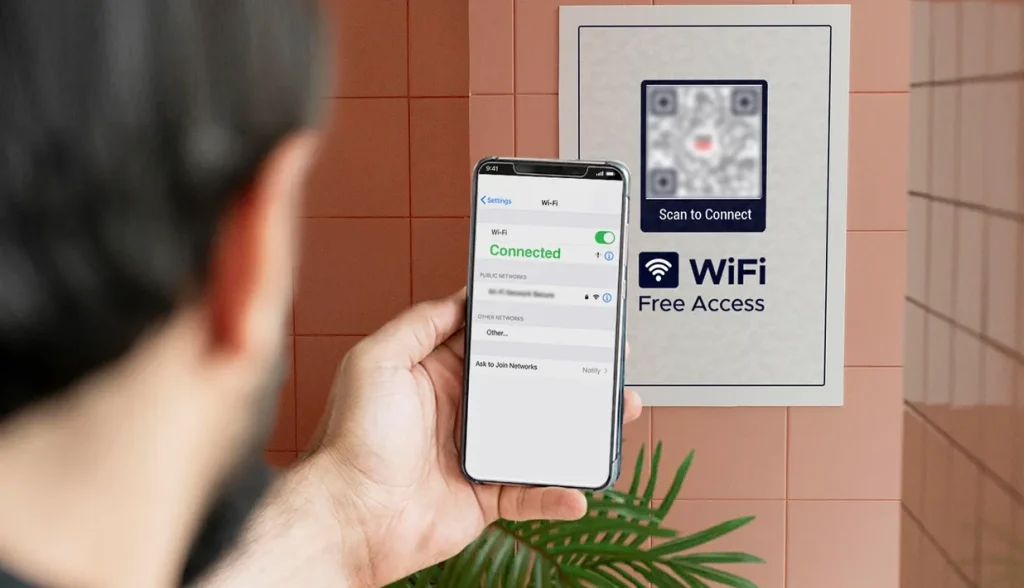
Join Wi-Fi
Many public and private networks now display QR codes that, when scanned, automatically connect your device to their Wi-Fi network. This removes the need to manually input network names and passwords, making the connection easier.
Cashless Payments
QR codes have become a cornerstone of cashless payment systems, particularly in Asia. Customers scan a merchant’s QR code to start a payment, or merchants scan the QR code on a customer’s phone. This offers a convenient and secure way to conduct transactions without physical cards or cash.

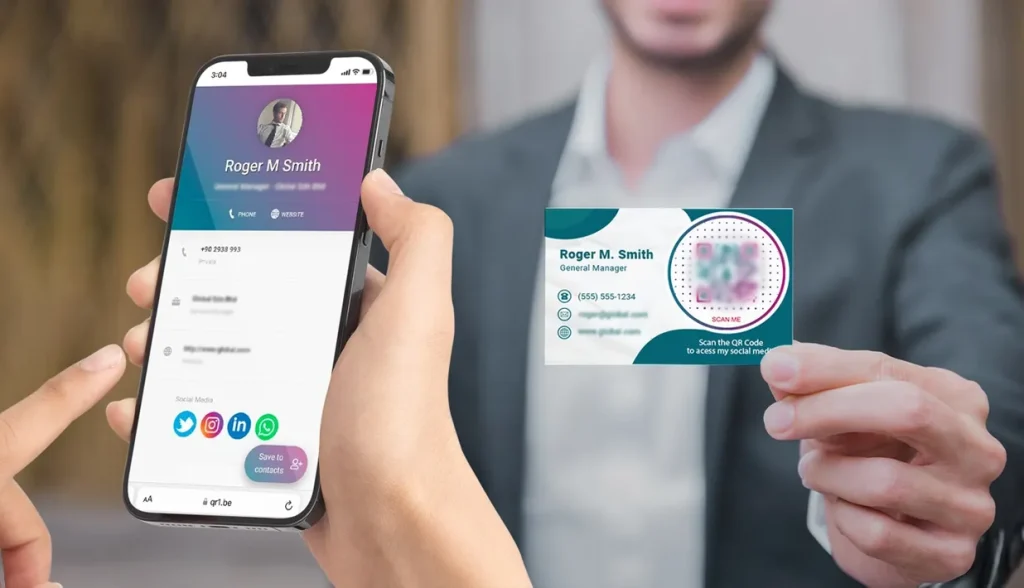
Business Cards
Digital business cards use QR codes to instantly share contact details. Instead of exchanging paper cards, professionals can simply have others scan their QR code, which can then automatically add their details to a phone’s contacts.
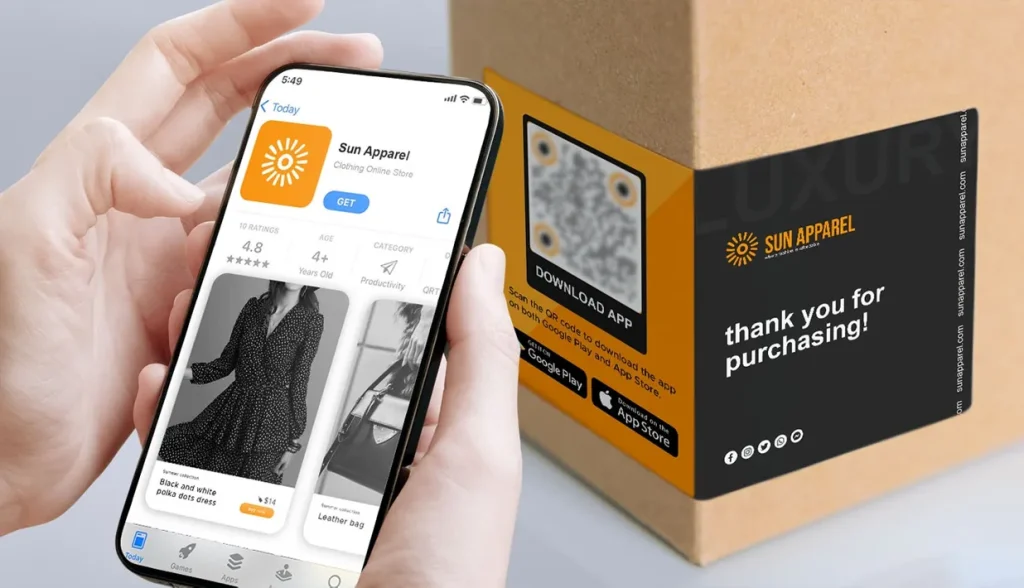
Download Apps
App developers often use QR codes in advertisements or on websites to provide a direct link to their application in app stores. Scanning the code immediately takes the user to the download page, streamlining the app acquisition process.
Digital Menus
Restaurants and cafes increasingly use QR codes to provide access to digital menus. Customers scan the code at their table to view the menu on their smartphone, reducing the need for physical menus and allowing for easy updates.
NFC VS QR: What’s the Difference?
While both NFC and QR codes facilitate seamless interaction between the physical and digital worlds, they achieve this through distinct mechanisms and offer different advantages.
| Read Distance | Efficiency | Security | Compatibility | Durability | Cost-Effectiveness | |
| QR | Up to 10 m | Quick and convenient | Can be easily copied, pasted, or tampered with | Compatible with any smartphone | Susceptible to physical damage | Inexpensive to set up |
| NFC | Within a few centimeters | Quick and convenient | Short-range communication with data encryption | Compatible with any NFC-enabled devices | Better long-term durability with durable materials | A little more expensive than the QR Code, but it offers better long-term ROI |

How to Choose Between NFC and QR?
The decision between NFC and QR codes is not about one being inherently superior, but rather about aligning the technology with your specific business objectives and user experience goals.
Consider Your Primary Goal
- For broad reach and general information sharing:
If your main objective is to disseminate information widely and quickly, and you need compatibility with almost any smartphone, QR codes are an excellent choice. They are perfect for marketing campaigns, linking to websites, or providing general product information where security is not a primary concern. - For secure, interactive, and personalized experiences:
If you require secure data exchange, real-time authentication, or want to offer a more intuitive, tap-and-go user experience, NFC is a better option. It excels in applications like mobile payments, access control, and product authentication, where proximity and data integrity are crucial.
Evaluate the User Experience
QR codes require users to open a camera app and scan the code, which can sometimes feel like an extra step. However, their visual nature makes them easily discoverable.
NFC provides a smooth, almost magical experience through a quick tap. This immediacy can lead to higher engagement rates for certain applications, especially where speed and convenience are paramount.
Assess Your Security Needs
If the data being accessed or the transaction being performed is sensitive, NFC provides a more secure communication channel due to its short range and encryption capabilities.
For non-sensitive information, QR codes are perfectly adequate, but be mindful of the potential for malicious QR codes.
Think about Durability and Environment
In harsh environments or for items that undergo wear and tear, NFC tags often offer greater durability and can be embedded more discreetly.
QR codes are best suited for clean, stable surfaces where they won’t be easily damaged or obscured.
Consider the Cost and Scalability
For very low-cost, high-volume deployments where basic linking is sufficient, QR codes are hard to beat on price.
While NFC tags have a slightly higher unit cost, their long-term benefits in terms of efficiency, security, and enhanced user experience can lead to a superior ROI for more complex or critical applications.
In many scenarios, businesses find that integrating both technologies provides the most comprehensive solution, leveraging the strengths of each for different touchpoints.
Conclusion
In the digital age, connecting the physical world with digital information is crucial for business success. Both NFC and QR codes are powerful tools that facilitate this connection, improving operational efficiency and enhancing customer experiences across diverse industries. While they share common goals, their underlying technologies and ideal applications differ significantly.
By carefully assessing your requirements for read distance, security, compatibility, durability, and cost-effectiveness, you can make an informed decision. Whether you choose NFC, QR codes, or a combination of both, these technologies are poised to continue transforming how businesses operate and how consumers interact with the world around them.






 EN
 ES
 JA