


By 2025, U.S. hospitals are expected to lose about $4,000 in equipment per bed due to theft or misplacement. Such losses can put significant strain on healthcare facilities, impacting both finances and operations. To tackle this problem, an effective tracking system is crucial. UHF RFID tags offer a smart solution, enabling real-time equipment monitoring and reducing unnecessary losses. By adopting RFID, healthcare providers can minimize losses, streamline maintenance, and ensure patient safety.
This article explores how UHF RFID is transforming healthcare equipment management, enhancing efficiency, and improving patient care.

What are UHF RFID Tags?
Ultra-high frequency (UHF) RFID tags are advanced identification tools that use radio waves to identify and monitor objects. They operate within a frequency range of 860MHz to 960MHz, offering faster data transmission and better scalability compared to low-frequency (LF) and high-frequency (HF) RFID tags.
The application of UHF RFID technology enables automated reading, reduces human error, and boosts operational efficiency in healthcare settings.
How UHF RFID Tags Enhance Healthcare Equipment Management?
Now that we’ve explored UHF RFID tags, let’s delve into how they revolutionize healthcare equipment management through five core advantages:
Improve Medical Device Management Efficiency
Hospitals handle thousands of medical devices, from ventilators to infusion pumps. Searching for misplaced equipment can be time-consuming and frustrating for healthcare staff. UHF RFID tags allow for real-time management and multiple scanning, making it easy for staff to quickly locate essential equipment. By tagging devices, hospitals can cut down on the time spent searching for lost tools, enhancing workflow, and improving patient care.

Enhance Healthcare Inventory Management
Keeping track of medical inventory is a complex task that often results in shortages or excess stock. Effective inventory management is crucial in hospitals. UHF RFID systems enable automated inventory checks, eliminating the need for manual counts. With instant access to data, administrators can monitor stock levels, prevent shortages, and ensure that critical medical supplies are always on hand.
Keep Precise Equipment Maintenance Records
Medical equipment needs routine maintenance to keep running smoothly. Old-school tracking methods can be clunky and error-prone. With UHF RFID technology, hospitals can store maintenance records right on the tag, offering live updates for service schedules. This forward-thinking approach helps avoid surprise breakdowns and keeps devices in top-notch condition.
Ensure Patient Safety
Proper equipment management ties directly to patient safety. Lost or poorly maintained devices can jeopardize patient care. Ultra-high frequency RFID-based asset tracking ensures medical equipment is cleaned, calibrated, and ready to go. This cuts down on the chances of equipment failure, delivering more dependable care for patients.

Reduce Labor Cost and Error
Manually tracking and managing medical equipment eats up time and invites mistakes. Hospitals need smarter ways to cut costs while staying efficient. RFID automation minimizes the need for manual input, slashing labor expenses and boosting accuracy. This lets staff spend more time focusing on patient care instead of paperwork.
Comparison of UHF RFID Tags and Barcode Labels in the Healthcare Equipment Industry
Both UHF RFID tags and barcodes can manage medical equipment, but UHF RFID takes management to the next level with better efficiency, accuracy, and scalability.
Read Range and Inventory Scanning
UHF RFID tags allow longer-range detection (up to 15 meters) and batch scanning all at once, significantly slashing inventory time. In contrast, barcodes rely on manual line-of-sight scanning, limiting efficiency to one item at a time.
Dynamic Storage Updates
UHF RFID tags support dynamic data updates and fully integrate with IoT-enabled healthcare systems, streamlining workflows and driving greater operational efficiency.
By contrast, barcodes only hold static, limited data, like fixed ID numbers. Updating them requires manual reprinting, increasing the risk of errors and delays, especially in high-pressure, critical care settings.
Operational Efficiency
Unlike barcode labels that rely on direct line-of-sight scanning, UHF RFID tags offer automated reading, simultaneous scanning of multiple tags, and real-time tracking. This drastically cuts scanning time and boosts operational efficiency in managing healthcare equipment.
Security
UHF RFID tags come equipped with encryption features like password protection and authentication protocols to block unauthorized data access. They offer real-time tracking with tamper-resistant mechanisms and minimize counterfeiting risks through dynamic data updates. On top of that, they integrate seamlessly with access control systems, ensuring only authorized personnel can gain entry.
On the flip side, barcodes lack encryption, store static data that’s prone to duplication or damage, and provide zero real-time security monitoring. As a result, UHF RFID dramatically boosts asset traceability and theft prevention, making it a game-changer for safeguarding high-value medical devices. In contrast, barcodes remain an easy target for security breaches due to their inherent limitations.
Conclusion
UHF RFID tags are transforming healthcare equipment management by enabling real-time, centimeter-level tracking of critical assets like life-saving devices, slashing operational downtime by 30-40% through automated inventory audits. With anti-tampering encryption and dynamic data updates, they help mitigate counterfeiting risks in high-value device supply chains while ensuring proper maintenance of medical equipment.
As hospitals shift toward smart, data-driven workflows, UHF RFID stands out as the backbone of a resilient, cost-effective asset ecosystem, breaking down operational silos and aligning seamlessly with global healthcare digitization trends.
Reach out to us for a cutting-edge UHF RFID solution customized specifically for the healthcare industry!
FAQs
What healthcare equipment can you use with UHF RFID tags?
UHF RFID tags can be used on ventilators, infusion pumps, defibrillators, surgical tools, hospital beds, and patient monitoring devices. Their versatility makes them an excellent choice for a wide variety of medical equipment.
Will UHF RFID tags be secure for healthcare equipment management?
Yes, UHF RFID tags utilize encrypted data and authentication protocols to block unauthorized access. They provide greater security compared to barcodes, lowering the risk of data breaches.
Can UHF RFID tags overcome interference issues in hospitals?
Hospitals house various electronic devices that can cause signal interference. Advanced UHF RFID systems leverage anti-collision algorithms and frequency-hopping technology to perform efficiently in RF-heavy environments, ensuring precise tracking.
By incorporating UHF RFID tags into healthcare equipment management, hospitals and medical facilities can boost efficiency, enhance security, and cut operational costs, leading to improved patient care and streamlined healthcare operations.
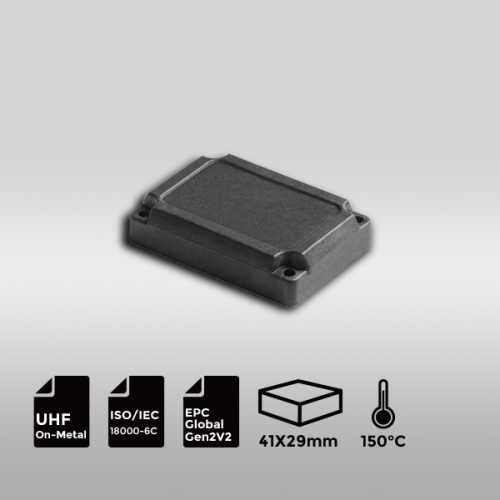
Chemical Resistant NXP UCODE® 8 PEEK RFID On-Metal Tag | 41×29 mm
This chemical resistant NXP UCODE® 8 PEEK RFID On-metal Tag adapts to pH 0–14 and endures harsh chemicals. It is perfect for asset tracking in medical devices, automotive and electronics industries where metal surfaces require durable tagging.

 EN
EN  ES
ES  JA
JA