

RFID Mattress Tracking from Factory to Hotel: A Complete Lifecycle Guide
Mattresses are high-value products that move through multiple stages before reaching the end user. Manual tracking methods and barcode labels often fail to provide the visibility businesses need, especially when managing thousands of mattresses across different locations.
RFID mattress tracking offers a smarter alternative by assigning every mattress a unique digital identity. With durable RFID tags and automated data capture, manufacturers, distributors, and hotels can improve inventory accuracy, streamline operations, and maintain complete lifecycle traceability from the factory floor to daily use.
1. What Is RFID Mattress Tracking
RFID mattress tracking is the use of Radio Frequency Identification (RFID) technology to identify and monitor mattresses throughout their lifecycle—from manufacturing and warehousing to hotel deployment and replacement.

A typical RFID mattress tracking system includes:
- RFID tags attached or sewn into each mattress to provide a unique digital identity.
- RFID readers installed at production lines, warehouse entrances, or used as handheld devices to capture tag data.
- RFID management software that stores information such as production records, inventory status, installation locations, warranty details, and maintenance history.
Compared with traditional barcode systems, RFID offers several advantages:
- Simultaneous reading of multiple mattresses.
- Faster inventory counts and shipment verification.
- Reduced manual data entry and scanning errors.
- End-to-end visibility throughout the mattress lifecycle.
2. Why Mattress Manufacturers and Hotels Need RFID Mattress Tracking
Managing mattresses is more complex than tracking ordinary inventory. A single mattress may pass through multiple positions before it reaches the end of its service life. Without a reliable identification system, maintaining accurate records becomes increasingly difficult.
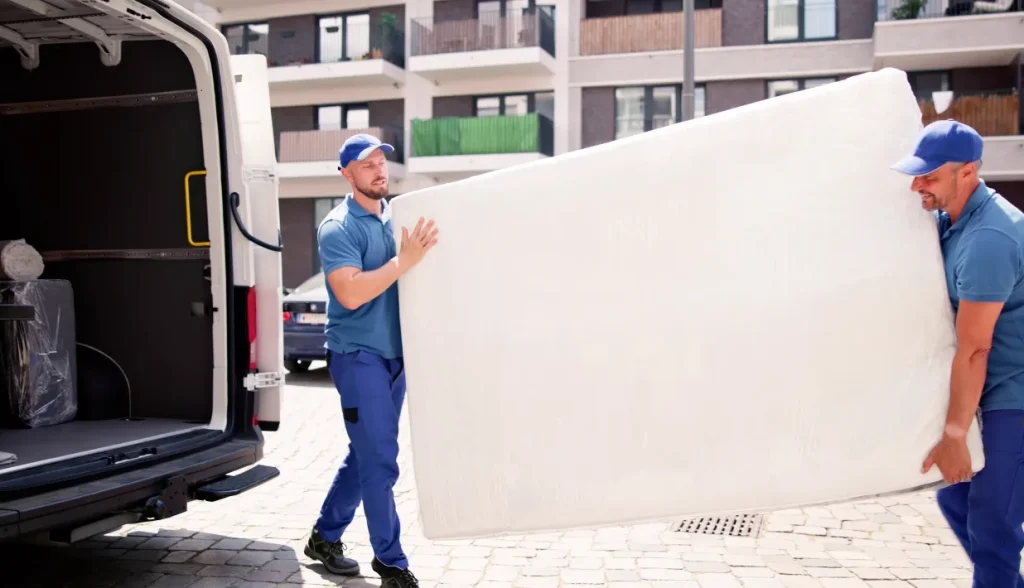
Common challenges include:
- Inventory inaccuracies caused by manual counting or misplaced products.
- Time-consuming warehouse operations, especially when receiving, shipping, or performing stock counts.
- Limited product traceability, making it difficult to identify production batches or warranty information.
- Asset loss or misplacement across warehouses, hotels, or healthcare facilities.
- Incomplete maintenance records, leading to missed inspections or delayed mattress replacement.
RFID addresses these challenges by creating a unique digital identity for every mattress. As tagged mattresses move through manufacturing, storage, transportation, and daily use, RFID readers automatically capture their locations and status without requiring manual scanning.
3. How RFID Mattress Tracking Works

An RFID mattress tracking system combines RFID tags, readers, and management software to create real-time visibility throughout the mattress lifecycle. Once a mattress is tagged, every movement can be automatically recorded without manual data entry. The process typically includes five steps:
3.1 Attach an RFID Tag During Manufacturing
Each mattress is fitted with a durable UHF RFID tag during production. Depending on the application, the tag may be sewn into the mattress border, embedded inside the mattress, or attached to the product label.
The tag contains a unique ID that serves as the mattress’s digital identity throughout its service life.
3.2 Register Product Information
The unique tag ID is linked to product information stored in the RFID management system, such as:
- Product model and size
- Serial or batch number
- Manufacturing date
- Production line
- Warranty information
This creates a complete digital record for every mattress.
3.3 Capture Data Automatically
As mattresses move through production lines, warehouse gates, or loading docks, fixed or handheld RFID readers automatically identify tagged items.
RFID read multiple mattresses at the same time without requiring direct line of sight, making inventory and shipping processes significantly faster.
3.4 Update the Management System in Real Time
Every RFID read updates the central database automatically. Users can instantly view information such as:
- Current location
- Inventory status
- Shipping records
- Installation history
- Maintenance activities
This eliminates manual record-keeping and reduces data errors.
3.5 Track the Mattress Throughout Its Lifecycle
The same RFID tag remains with the mattress from production to daily use. As a result, manufacturers, distributors, hotels, and healthcare facilities can access a continuous history of the asset, improving traceability, maintenance planning, and replacement decisions.
4. RFID Mattress Tracking Throughout the Entire Lifecycle
One of the biggest advantages of RFID mattress tracking is that the same RFID tag can remain with the mattress throughout its entire lifecycle. From the production line to daily use in hotels or healthcare facilities, every movement and status update can be automatically recorded.

4.1 Manufacturing: Build Traceability from Day One
The RFID journey begins during production, where each mattress receives a unique digital identity.
Manufacturers can use RFID to:
- Identify every mattress individually.
- Track work-in-progress (WIP) across production stages.
- Record quality inspection results.
- Link products to production batches and manufacturing dates.
- Reduce product mix-ups before packaging.
This creates complete production traceability and simplifies quality control if issues are discovered later.
4.2 Warehouse and Logistics: Improve Inventory Accuracy
After production, RFID helps automate warehouse operations without relying on manual barcode scanning.
Common applications include:
- Automatic receiving and put-away.
- Faster inventory counts.
- Shipment verification before loading.
- Real-time warehouse visibility.
- Quick identification of misplaced inventory.
Since UHF RFID readers can identify multiple mattresses simultaneously, warehouses can process large shipments more efficiently while improving inventory accuracy.
4.3 Distribution: Maintain Product Visibility
As mattresses move through distributors or retail warehouses, RFID continues to provide end-to-end visibility.
Businesses can easily:
- Verify outbound and inbound shipments.
- Confirm product authenticity.
- Track delivery status.
- Access manufacturing information using the unique RFID ID.
- Reduce shipping errors between distribution centers.
This continuous traceability helps ensure the right products arrive at the correct destination.
4.4 Hotel Asset Management: Track Every Mattress in Service
Hotels often manage hundreds or even thousands of mattresses across multiple properties. Without an identification system, tracking installation dates, maintenance history, and replacement schedules can become difficult.
With RFID mattress tracking, hotel staff can quickly access information such as:
- Mattress location or room number.
- Installation date.
- Cleaning and inspection history.
- Rotation schedule.
- Warranty status.
- Planned replacement date.
This improves asset visibility while helping hotels maintain consistent guest comfort and operational standards.
4.5 Maintenance and End-of-Life Management
RFID continues to deliver value long after a mattress enters service.
Maintenance teams can use RFID records to:
- Schedule routine inspections.
- Track repairs and maintenance history.
- Identify mattresses approaching the end of their service life.
- Plan replacements based on actual usage rather than estimates.
- Maintain complete lifecycle records for auditing purposes.
Instead of relying on paper records or manual spreadsheets, organizations gain accurate, data-driven insights that support better asset management decisions.
5. What RFID Tags Are Best for RFID Mattress Tracking
Choosing the right RFID tag is just as important as selecting the right tracking system. The ideal tag should withstand years of daily use while maintaining reliable read performance throughout the mattress lifecycle.

When evaluating RFID tags for mattress tracking, consider the following factors:
- Durability to withstand compression, handling, and long-term use.
- Reliable read performance in warehouses, hotels, and healthcare facilities.
- Flexible installation without affecting mattress comfort or appearance.
- Long service life, allowing the same tag to remain with the mattress from production to replacement.
Several RFID tag types can be used, depending on the application.
| RFID Tag Type | Typical Application |
| UHF RFID Laundry Tag | Long-term lifecycle tracking |
| Textile RFID Tag | Mattress manufacturing and asset management |
| RFID Label | Warehouse and logistics only |
| Embedded RFID Tag | Premium mattresses and anti-tampering applications |
For most manufacturers and hotels, UHF RFID laundry tags are an excellent choice. Although originally designed for industrial laundry applications, their flexible construction and high durability also make them well suited for mattress tracking. The tag can be sewn into the mattress border during manufacturing and remain in place throughout the entire service life of the mattress.
RFIDTag offers high-performance UHF RFID laundry tags designed for long-term asset identification and lifecycle management. Visit our website to select the RFID tags that best fit your requirements.
6. Conclusion
RFID mattress tracking provides a smarter way to manage mattresses from production to daily use. By giving each mattress a unique digital identity, businesses can improve inventory accuracy, automate warehouse operations, enhance asset visibility, and maintain complete lifecycle traceability.
Looking to build an RFID mattress tracking solution? Contact us to explore durable UHF RFID laundry tags and customized RFID solutions tailored to your application.
FAQs
1. Can RFID tags be embedded inside a mattress?
Yes. RFID tags can be sewn into the mattress border, integrated into the product label, or embedded inside the mattress during manufacturing. The best installation method depends on your production process, durability requirements, and whether the tag needs to remain visible for maintenance or warranty purposes.
2. Can RFID laundry tags be used for mattress tracking?
Yes. UHF RFID laundry tags are widely used for long-term asset identification because they are durable, flexible, and designed to withstand demanding environments. When sewn into a mattress during manufacturing, they can support tracking throughout production, warehousing, transportation, and hotel or healthcare operations.
3. What is the best RFID frequency for mattress tracking?
For most mattress tracking applications, UHF RFID (860–960 MHz) is the preferred choice. It offers a longer read range, supports bulk reading, and is well suited for warehouse management, logistics, and large-scale asset tracking where multiple mattresses need to be identified quickly.









 EN
 ES
 JA