


Ever wondered how fashion giants like Zara or Uniqlo keep track of thousands of items in stock and can instantly tell you if something is available? The secret is a tiny RFID tag. RFID tags are much more than just a tech term—they’re an efficient tool reshaping the way businesses operate. In this post, we’ll dive into how RFID tags are making an impact in 7 key areas.
RFID Tag for Beginners: What is an RFID Tag?

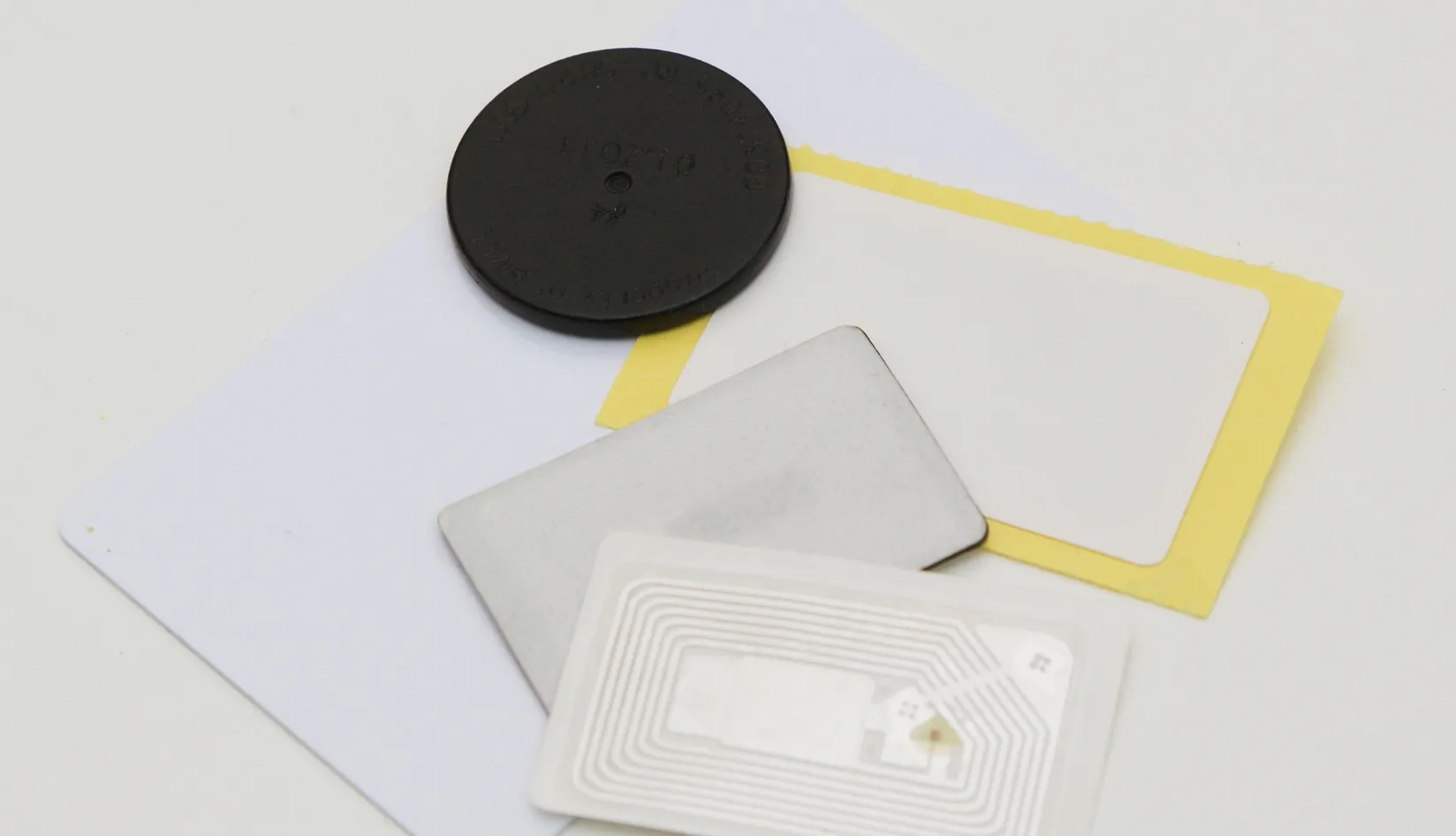
An RFID tag is a small electronic device that uses radio waves to wirelessly transmit data to an RFID reader. It typically consists of two main components: a microchip, which stores information, and an antenna, which sends and receives radio signals. Unlike traditional barcodes, RFID tags can be read without a direct line of sight, allowing for faster and more efficient data collection.
What Does an RFID Tag Work?
An RFID system generally comprises three components: an RFID tag (transponder), an RFID reader (transceiver), and an antenna. The reader emits radio waves through its antenna, creating an electromagnetic field. When an RFID tag enters this field, the tag’s antenna picks up energy from the radio waves, powering its microchip. The microchip then modulates the radio waves to send its stored data back to the reader. The reader converts these radio waves into digital data, which can then be processed by a computer system.
Passive RFID Tags VS Active RFID Tags:
- Passive RFID Tags: They are small, affordable, and ideal for applications like inventory tracking and access control. They draw energy from the RFID reader’s electromagnetic field, making them cost-effective while providing efficient performance in short-range applications.
- Active RFID Tags: They are equipped with their own power source (typically a battery), allowing them to broadcast signals over longer distances and store more data. Active tags are often used for tracking high-value assets, vehicles, or in real-time location systems (RTLS).
How much are RFID Tags?
The cost of RFID tags varies widely depending on the type, memory size, and intended use. Passive RFID tags, which don’t have their own power source, are the most affordable—typically ranging from $0.10 to $0.50 per tag when purchased in bulk.
7 Powerful Ways Industries are Using RFID Tags Today
RFID technology offers diverse applications that significantly improve efficiency, accuracy, and security across various sectors. Here are seven prominent examples:
1. RFID Tags in Retail Inventory Management
In the retail sector, RFID tags have transformed inventory management. By attaching RFID tags to individual items, retailers can promise high inventory accuracy (often exceeding 95%). This allows for real-time visibility into stock levels, reduces out-of-stock situations, and minimizes overstocking. Staff can quickly locate specific items, conduct rapid inventory counts, and improve replenishment processes, leading to better sales and enhanced customer satisfaction.
2. RFID Tags in Supply Chain and Logistics Tracking
RFID plays a crucial role in optimizing supply chain visibility and logistics. Tags can be applied to pallets, containers, or individual products, enabling automated tracking from manufacturing to the point of sale. They provide real-time data on goods movement, help prevent projects loss and theft, and streamline receiving and shipping processes. Companies can better manage their warehouses, reduce manual errors, and improve overall operational efficiency
3. RFID Tags in Asset Tracking and Management
RFID tags are widely used in industries like healthcare, IT, and manufacturing to track assets. Hospitals track medical equipment and patients, while IT departments manage servers. This ensures assets are accounted for, easily located, and well-maintained, reducing costs and improving accountability.
4. RFID Tags in Access Control and Security
RFID is key in modern access control systems, with cards and fobs used to manage entry to buildings and secure areas. These systems offer enhanced security compared to traditional keys, with easy access management and monitoring.
5. RFID Tags in Event Management and Ticketing
At large events and theme parks, RFID wristbands and tickets streamline entry, cashless payments, and crowd control. They reduce queues, improve attendee experience, and offer real-time attendance tracking and security against counterfeit tickets.
6. RFID Tags in Livestock and Pet Identification
RFID microchips are implanted in animals for identification and tracking, helping farmers monitor livestock and manage breeding. For pets, RFID chips provide permanent identification, reducing the risk of them getting lost.
7. RFID Tags in Manufacturing and Production Process Automation
RFID tags help automate production tracking, quality control, and assembly line management. They store data about manufacturing stages and components, enabling real-time monitoring and improving manufacturing efficiency.
RFID vs. NFC for Everyday Use
In our wireless world, RFID and NFC are often mentioned together, but understanding their differences is key to choosing the right tool for the job. Think of it this way: NFC is a specialized subset of RFID, designed for close-range, secure two-way communication.
RFID is the long-range workhorse. Operating at UHF frequencies, it can scan dozens of items from several meters away. This makes it perfect for efficient inventory management in warehouses or tracking items in a supply chain – think of a pallet of goods being scanned instantly without unpacking.
NFC, on the other hand, is all about intimacy and security. It requires a very close proximity (within a few centimeters). This limitation is its strength, enabling secure applications like contactless payments (Apple Pay, Google Wallet), access control for offices, and smart interactions like tapping a phone to a poster for information.
If you need to track many assets quickly from a distance, UHF RFID is your solution. If you require secure, intentional interactions between a device and a tag, NFC is the winner. As a professional RFID card and tag factory, ACCUZ helps clients navigate these choices to implement the most effective technology for their specific needs.
Conclusion
RFID technology has evolved into an indispensable tool for businesses seeking to enhance efficiency, accuracy, and security. From optimizing retail inventory and streamlining logistics to securing access and automating manufacturing, the applications of RFID tags are vast and continue to expand. As a leading manufacturer of RFID cards and tags, ACCUZ is at the forefront of providing customizable and high-quality RFID solutions that empower businesses across North America, Europe, and the UK to leverage these transformative capabilities.
FAQs
What is the main difference between RFID and barcodes?
The primary difference is that RFID tags use radio waves to transmit data wirelessly, allowing for non-line-of-sight reading and reading multiple tags simultaneously. Barcodes require a direct line of sight for scanning and can only be read one at a time.
Are RFID tags secure? Can they be easily cloned or hacked?
While no technology is entirely immune to security risks, RFID tags incorporate various security features like encryption and authentication protocols to prevent unauthorized access and cloning. The level of security can vary depending on the type of RFID tag and the system implementation.
How far can an RFID tag be read?
The read range of an RFID tag varies significantly based on its type (passive vs. active), the frequency used, the power of the reader, and environmental factors. Passive tags typically have a read range from a few centimeters to several meters, while active tags can be read from tens to hundreds of meters.
What industries benefit most from RFID technology?
Industries that benefit significantly include retail (for inventory management), logistics and supply chain (for tracking goods), healthcare (for asset and patient tracking), manufacturing (for process automation), and access control (for security).
Is RFID technology environmentally friendly?
Many RFID tags are designed to be eco-friendly, with options for recyclable materials. The technology itself can contribute to sustainability by optimizing supply chains, reducing waste, and improving resource management.
Recommended Product

Concrete NXP UCODE® 8 PPS RFID Tag | 46.5×31.5mm
The UHF Concrete RFID Tag PPS with NXP UCODE® 8 delivers reliable long-range tracking embedded in concrete or harsh surfaces. With strong heat, corrosion, and impact resistance, it meets the tough demands of the construction industry for asset management and structure monitoring.



 EN
EN  ES
ES  JA
JA