


Introduction
Radio-Frequency Identification (RFID) technology has revolutionized various industries, offering efficient solutions for tracking, inventory management, and access control. At the heart of this technology lies the RFID tag, a small yet powerful device that enables wireless data exchange. How these intricate tags are brought to life, from their fundamental components to the final product? It is key to appreciating their widespread application and future potential. This guide delves into the comprehensive journey of RFID tag manufacturing, exploring each critical stage.
The Core Components of an RFID Tag

Before diving into the manufacturing process, it’s essential to understand the primary constituents of any RFID tag. These components work in harmony to facilitate the tag’s functionality.
Integrated Circuit (IC) – The Brain of the Tag
The Integrated Circuit, often referred to as the microchip or IC, is the data processing and storage unit of the RFID tag. It holds unique identification numbers, application-specific data, and communicates with the RFID reader. The IC is typically manufactured from silicon, undergoing a complex fabrication process similar to other microprocessors.
Antenna – The Communication Link
The antenna is crucial for transmitting and receiving radio signals between the RFID tag and the reader. Its design and material are critical for determining the tag’s read range and performance characteristics. Antennas can vary significantly in size and shape, depending on the frequency band and intended application of the tag.
Substrate – The Foundation
The substrate provides the physical foundation upon which the IC and antenna are mounted. It’s a non-conductive material, often made from plastic (like PET or PVC), paper, or synthetic polymers. The choice of substrate depends on the tag’s intended environment and durability requirements.
The Manufacturing Journey: From Raw Materials to Finished Product

The creation of an RFID tag is a multi-step process, combining advanced microelectronics fabrication with precise assembly techniques. Each stage is vital to ensure the tag’s reliability and performance.
IC Manufacturing: Crafting and Installing the Microchip
The chip installation process follows the completion of the integrated circuit fabrication. The ICs are first produced on large silicon wafers within highly controlled environments, starting from a single-crystal silicon ingot that is sliced into wafers, followed by the etching and deposition of circuitry through photolithography. Once the individual chips are diced from these wafers, they proceed to the chip bonding stage, where flip-chip bonding technology is employed to mount them onto antennas and ensure a reliable electrical connection.
Antenna Manufacturing: Building the Signal Path
Antennas for RFID tags are typically made from conductive materials such as aluminum, copper, or conductive inks. Various methods are employed, including etching, printing, or depositing vaporized metals onto the substrate to create the antenna pattern. The precision of this step directly impacts the tag’s ability to communicate effectively.
IC Attachment (Chip Bonding): Uniting Brain and Body
The foundation of an RFID tag is its substrate, with materials such as plastic (for flexible tags) or paper (for disposable tags) being selected based on the required application and durability. The core functional element is established during IC Attachment (Chip Bonding), a process that unites the brain and body. This is achieved by placing a microscopic IC onto a precise drop of conductive epoxy on the antenna and curing it under heat and pressure to ensure a solid electrical connection. The result of this process is known as an inlay. Subsequently, this inlay is protected from environmental factors like heat and moisture through encapsulation via lamination or coating.
Converting: Shaping the Inlay into a Usable Tag
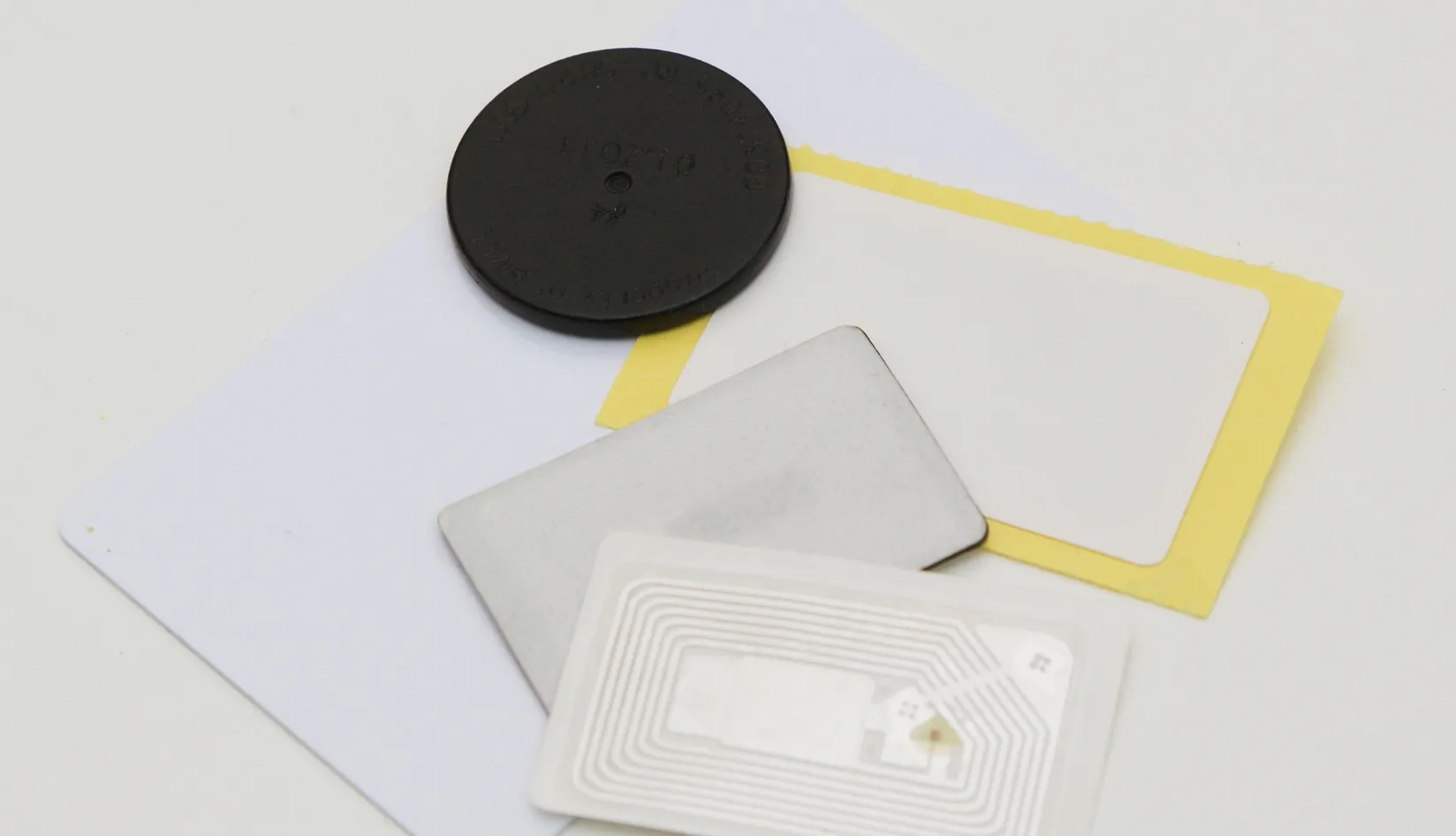
Once the inlay is formed, it undergoes the converting process, transforming it into a finalized RFID tag suitable for its application. This stage involves adding protective layers, printable surfaces, adhesives, and liners. Depending on the end-product, inlays can be converted into various formats:
Label Converting
For RFID labels, protective and printable layers are added on top of the inlay, while an adhesive layer and a removable liner are applied to the bottom. This creates a ready-to-use sticker-like tag.
Hard Tags
Inlays destined for harsh environments are often encased within durable, protective housings, forming hard tags. These are commonly used for asset tracking in industrial settings.
Other Formats
RFID inlays can also be integrated into smart cards, hangtags, wristbands, or even embedded directly into products like car tires, offering tailored solutions for diverse needs.
Personalization: Imbuing the Tag with Data
Personalization is the process of adding data to the RFID tag, effectively making it unique and functional. This involves both electronic encoding and physical printing.
Encoding the IC
Data is written to the IC’s memory banks, including the Electronic Product Code (EPC), Tag Identifier (TID), and user memory. This encoding can follow standards like EPC Tag Data Standard or NFC encoding protocols, depending on the tag type and application. For instance, in RAIN RFID, the EPC memory often contains a company prefix and a unique serial number, allowing for precise item identification.
Printing Visual Information
Many tags require visual information such as barcodes, 2D codes, logos, and human-readable text. This printing must align with the encoded data and often adheres to strict brand guidelines. The combination of electronic encoding and visual printing ensures the tag is both machine-readable and human-identifiable.
Tagging the Item: Deployment and Integration
The final step is attaching the finished RFID tag to the item it will track. This can range from manual attachment in test projects to automated source tagging during the item’s manufacturing process. Source tagging, where the item’s manufacturer integrates the RFID tag, offers significant benefits by enabling tracking throughout the supply chain [4] from the outset, minimizing handling and potential damage. Service bureaus often play a crucial role here, handling personalization and attachment for manufacturers.
The Challenges You Must Notice in RFID Tag Manufacturing
RFID tag manufacturing requires a precise balance of performance, durability, and cost. The selection of materials – from chips and antennas to protective encapsulation – directly impacts the tag’s capabilities and price point. Manufacturers must optimize designs to achieve the required read range, data speed, and environmental resistance while maintaining cost-effectiveness for specific applications.
The operational reliability of tags presents another critical challenge. Products must be engineered to withstand real-world conditions including extreme temperatures, moisture, physical impact, and electromagnetic interference. This demands sophisticated antenna design and robust encapsulation techniques to ensure consistent performance across various environments and use cases.
Explore our RFID solutions and find the best product for your needs. For more information, visit our website or contact our online customer service for personalized assistance.
The Applications of RFID Tag
| Type | Frequency Range | Key Characteristics | Common Applications |
| Low Frequency (LF) RFID | 125 kHz – 134 kHz | • Short Read Range: Typically < 10 cm • High Resilience: Penetrates water, metal, and tissue well • Slower Data Transfer • Lower Cost | • Animal Tracking (pet & livestock ID) • Access Control (key cards for buildings) • Automotive Immobilizers (car key chips) • Industrial Environments (harsh, wet conditions) |
| High Frequency (HF) RFID / NFC | 13.56 MHz | • Medium Read Range: 10 cm to 1 m • Faster Data Transfer & better security (encryption) • Global Standard (ISO 14443/15693) • NFC is a subset for device-to-device communication | • Contactless Payments (credit/debit cards, mobile wallets) • Library Management (book tracking) • Ticketing (transit passes, event tickets) • Patient & Asset Tracking (in hospitals) |
| Ultra-High Frequency (UHF) RFID | 860 MHz – 960 MHz (Regional variations) | • Long Read Range: Up to 10-12m (passive); 100m+ (active) • Fast Bulk Reading: 100s of tags per second • Susceptible to Interference from water and metal | • Supply Chain & Retail Inventory (pallet/case tracking) • Asset Tracking (IT equipment, tools in warehouses) • Pharmaceutical Anti-Counterfeiting • Race Timing (marathons, triathlons) |
.
Conclusion
The journey of an RFID tag from a tiny silicon chip to a fully functional product is a testament to precision engineering and advanced manufacturing techniques. Each step, from IC and antenna fabrication to attachment, converting, personalization, and final tagging, contributes to creating a robust and reliable device. As RFID technology continues to evolve, understanding this intricate manufacturing process provides valuable insight into its capabilities and the innovative solutions it offers across countless industries.
FAQs
Q1: What is the primary function of an RFID tag?
A1: The primary function of an RFID tag is to act as a wireless data carrier, allowing objects to be uniquely identified and tracked through radio waves—without the need for direct contact or line of sight. If you want a high-performance tracking on metal surfaces, consider our On-Metal UHF RFID PCB Tag NXP UCODE® 8, designed for durability and reliable read accuracy in industrial environments.
Q2: How do passive RFID tags get their power?
A2: Passive RFID tags do not have an internal power source. Instead, they draw power from the electromagnetic field generated by the RFID reader’s antenna. This energy activates the tag’s IC, allowing it to transmit its data.
Q3: What is the difference between an inlay and a finished RFID tag?
A3: An inlay is the core component of an RFID tag, consisting of the IC (chip) attached to the antenna on a substrate. A finished RFID tag is the inlay after it has undergone the converting process, where protective layers, adhesives, and printable surfaces are added to make it a usable product like a label or hard tag.
Q4: Can RFID tags be reprogrammed?
A4: Many RFID tags, especially those with user memory, can be reprogrammed or updated with new information. This capability makes them versatile for applications requiring dynamic data storage, such as tracking reusable assets or updating inventory details.
Q5: What are some common applications of RFID tags?
A5: RFID tags are used in a wide range of applications, including supply chain management, inventory tracking, access control, toll collection, retail item-level tagging, animal identification, and even in passports for enhanced security.
Recommended Product

Concrete Alien Higgs® 9 PPS RFID Tag | 46.5×31.5 mm
The Alien Higgs® 9 Concrete RFID Tag uses durable PPS housing for outstanding heat, impact and corrosion resistance. Ideal for embedding into concrete structures, this UHF tag provides long-range performance and ensures accurate tracking in demanding construction and civil engineering projects.

Alien Higgs® 9 ABS and steel wire RFID Seal Tag
The Alien Higgs® 9 ABS and Steel Wire RFID Seal Tag is engineered for secure, tamper-evident sealing in demanding logistics and industrial settings. Made of high-quality ABS and robust steel wire, it prevents unauthorized opening while delivering high data accuracy. Resistant to electromagnetic interference and pollution, the Alien Higgs® 9 chip supports fast reading, anti-cloning, and large-scale programming, making it a powerful choice for asset protection, truck door sealing, and wellhead valve security.

Alien Higgs® 9 RFID UHF Spring Tire Tag
The UHF RFID Tire Tag with Alien Higgs® 9 chip and durable steel wire is purpose-built for long-term tire tracking in challenging environments. Its compact form factor allows seamless embedding during tire manufacturing, while its heat resistance up to 85°C ensures performance under high-stress conditions. With anti-counterfeiting, dynamic authentication, and a unique identifier, this tag provides robust data security and accurate tracking. Ideal for use in trucks, buses, auto plants, and fleet logistics.

Alien Higgs® 9 RFID UHF Tire Patch Tag – Inner Sidewall Installation
The Alien Higgs® 9 RFID UHF Tire Patch Tag is engineered for robust, long-term tire tracking. Designed to be attached directly to the inner sidewall of tires, it is made from flexible, heat-resistant rubber that withstands harsh conditions. Powered by the Alien Higgs® 9 chip, it offers real-time authentication, anti-counterfeiting technology, and a unique ID to prevent duplication and theft. Ideal for use in buses, trucks, factory vehicles, and fleet logistics, this tag ensures reliable performance throughout the tire lifecycle.



 EN
EN  ES
ES  JA
JA