

How to Enhance Asset Tracking with RFID Tags?
In today’s fast-paced global industries, effective asset tracking with RFID tags is essential to overcome challenges like misplaced equipment, inefficient inventory management, and a lack of real-time visibility. As businesses strive to boost operational efficiency, RFID technology offers a transformative solution, delivering accurate, real-time asset visibility.
This article explores how RFID tags can optimize asset tracking processes, provide tangible business benefits, and help organizations address their key asset management hurdles.
Why does Efficient Asset Tracking Matter?
Efficient asset tracking is essential for operational excellence and financial health. Without a robust system, organizations face costly delays, increased labor, and project setbacks caused by misplaced tools or equipment.
Poor asset data can lead to over-purchasing, underutilization, or loss due to theft or obsolescence. In industries like healthcare, construction, and manufacturing, ineffective tracking can compromise safety, compliance, and service quality. Ultimately, real-time asset insights enable better resource allocation, reduce waste, improve accountability, and ensure smooth, profitable operations.
What is Asset Tracking with RFID Tags?
Asset tracking with RFID tags involves attaching RFID tags to assets, which are then read by RFID readers to provide real-time location and status updates. Unlike barcode systems that require line-of-sight, RFID uses radio waves for quick, automated identification of multiple assets simultaneously, even when not visible.
How Does RFID Asset Tracking Work?
RFID asset tracking systems operate through a continuous cycle of tagging, reading, and data management. Assets are tagged with unique RFID labels or tags, which are then read by strategically placed fixed or handheld RFID readers that emit radio waves to capture these identifiers.
The reader transmits the data—comprising the tag ID, location, and timestamp—to a central system or cloud platform. RFID software processes this information, linking it to detailed asset data stored in a database, enabling real-time visibility, location tracking, and movement history.
This system provides actionable insights via dashboards, helping optimize operations, monitor asset status, and maintain comprehensive audit trails.
Benefits of RFID Asset Tracking
Implementing RFID for asset tracking yields a multitude of benefits that directly contribute to a business’s efficiency, profitability, and strategic decision-making.
Enhance Asset Management Efficiency
RFID systems automate the process of identifying and locating assets, drastically reducing the time and labor traditionally spent on manual inventory counts and searches. This automation frees up staff to focus on more value-added tasks, leading to significant improvements in operational efficiency across departments.
Optimize Asset Visibility and Traceability
With RFID, businesses gain real-time, item-level visibility into their assets. They can track the exact location of equipment, tools, and inventory at any given moment, whether they are in storage, in transit, or in use. This enhanced traceability provides a complete audit trail for each asset, improving accountability and compliance.
Improve Management Accuracy
Manual asset tracking is prone to human error, leading to discrepancies between recorded and actual inventory. RFID virtually eliminates these errors, providing highly accurate data that ensures inventory records are always up-to-date. This accuracy is crucial for financial reporting, resource planning, and preventing costly mistakes.
Provide Data Insights
RFID systems collect a wealth of data on asset movement, usage patterns, and maintenance history. This data can be analyzed to provide valuable insights into asset utilization, performance, and lifecycle costs. Businesses can use these insights to optimize asset deployment, schedule predictive maintenance, and make informed decisions about future asset investments.
Eliminate Asset Loss and Theft
By providing real-time location data and enabling automated alerts when assets move unexpectedly, RFID significantly reduces the incidence of lost or stolen equipment. Geofencing capabilities can be implemented to trigger alarms if an asset leaves a designated area, providing an effective deterrent against theft and improving asset security.
Reduce Cost
The cumulative effect of enhanced efficiency, improved accuracy, reduced loss, and optimized asset utilization is a significant reduction in operational costs. Businesses save money on labor, replacement costs for lost items, unnecessary purchases, and even insurance premiums. The return on investment (ROI) for RFID asset tracking systems can be substantial, making it a financially sound decision for many organizations.
Active RFID Asset Tracking VS. Passive RFID Asset Tracking
| Power Supply | Reading Range | Cost | Maintenance | Data Storage | |
| Active RFID Asset Tracking | Built-in Battery | Up to 150 m | Higher than passive RFID, and the benefits outweigh the costs | Requires battery replacement | Can store more data compared to |
| Passive RFID Asset Tracking | Powered by the reader’s radio waves | Up to 15 m | Cheaper than active tags. | No need for battery replacement | Limited data storage capacity |

RFID VS Barcode: Which is Better for Asset Tracking?
For decades, barcodes have been the standard for asset identification. However, RFID technology offers significant advantages that make it a superior choice for modern asset tracking needs.
| Durability | Cost | Read Efficiency | Data Storage | |
| Barcode | Can be damaged or removed, rendering them unusable | Cheaper to implement than RFID | Require line-of-sight | Limited, stores less information than RFID tags |
| RFID | can withstand harsh environments. | Higher than barcodes | Enable automated asset tracking, enhance read efficiency | Capable of storing more data than barcodes |
Common RFID Tags for Asset Tracking in Various Industries
The diversity of RFID tags allows for specialized solutions tailored to the unique demands of different industries.
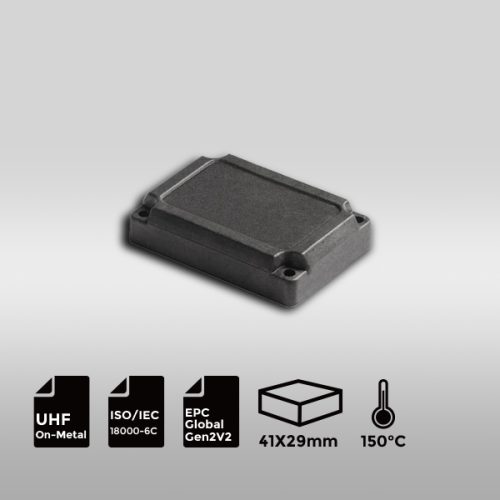
Heat-resistant RFID on-metal tags for asset tracking in Manufacturing
In manufacturing environments, assets like tools, machinery, and work-in-progress often operate in high-temperature conditions. Heat-resistant RFID on-metal tags with durable materials like PEEK are specifically designed to withstand extreme temperatures, ensuring reliable tracking and data integrity even in challenging industrial settings. These tags are robust and can be directly mounted on metal surfaces without performance degradation.
Chemical-Resistant RFID On-Metal Tags for Healthcare Asset Tracking
Healthcare facilities require stringent tracking of medical equipment, instruments, and supplies, often exposed to harsh cleaning agents and chemicals. Chemical-resistant RFID on-metal tags can endure such environments, providing durable and reliable tracking for critical assets, ensuring patient safety, and operational efficiency.
Concrete RFID on-metal tags for Construction Asset Tracking
Construction sites are notoriously tough environments. Concrete RFID on-metal tags can withstand impacts, abrasions, and exposure to dirt, dust, and moisture. They are ideal for tracking heavy machinery, tools, and materials on construction sites, providing real-time visibility and preventing loss or theft.
Conclusion
RFID technology is transforming asset tracking across various industries by providing real-time, accurate visibility of asset location and status. This enables businesses to improve inventory management, streamline operations, reduce costs, prevent loss, and optimize resource use. Whether in retail, manufacturing, or healthcare, RFID asset tracking drives operational efficiency and delivers a strong return on investment.
FAQs
Are RFID asset tags suitable for harsh industrial environments?
Yes, many RFID asset tags are specifically designed to withstand harsh industrial environments. Manufacturers produce ruggedized tags that are resistant to extreme temperatures, moisture, chemicals, impacts, and abrasions.
How does RFID technology handle large-scale asset tracking across multiple sites?
RFID technology is highly scalable and well-suited for large-scale asset tracking across multiple sites. This is achieved through a networked system of RFID readers and a centralized software platform. Fixed readers can be deployed at various checkpoints (e.g., entry/exit points, storage areas) across different sites, continuously monitoring asset movement. Data from all readers is then aggregated and processed by the central system, providing a unified, real-time view of all assets regardless of their physical location. Cloud-based solutions further enhance this capability, allowing for remote monitoring and management of assets across geographically dispersed locations.












 EN
 ES
 JA